
Quick answer: Start by defining your event requirements, then evaluate AV companies against six criteria: local venue experience, full-service capability, equipment quality and ownership, staffing model, pre-production process, and insurance and redundancy planning. Score finalists with a weighted scorecard, and disqualify providers that show red flags like vague proposals or no site visit.
Choosing the Right Audiovisual Company in Northern Virginia Starts with a Framework

You have an event on the calendar, a venue locked in, and a growing list of technical needs – but finding the right audiovisual company in Northern Virginia feels like navigating a maze of vague proposals and inconsistent pricing. You are not alone. Selecting the right AV partner is one of the most common logistical stressors planners tell us about. The stakes are high: a single microphone failure during a keynote or a dim projector in a sunlit ballroom can derail months of planning in seconds.
This guide is not a generic listicle of tips. It is a structured decision-making framework designed specifically for corporate planners, association directors, and organizational leaders who produce events across the Northern Virginia corridor – from Tysons Corner and Reston to Arlington, Alexandria, and Fairfax. By the time you finish reading, you will have a clear, repeatable process for evaluating, comparing, and selecting an AV partner that matches the complexity of your event.

Step 1: Define Your Event Requirements Before You Start Searching

The biggest mistake planners make is contacting AV companies before they understand their own needs. Without clear requirements, you will receive proposals that are impossible to compare apples-to-apples. Before you pick up the phone or send an RFP, document the following:
Event Profile Essentials
- Event type: Is this a corporate conference, gala, awards ceremony, product launch, town hall, or hybrid broadcast? Each demands different AV configurations.
- Audience size: A 75-person boardroom presentation has entirely different audio and visual requirements than a 2,000-seat general session.
- Venue specifics: Northern Virginia venues range from modern hotel ballrooms in Tysons to historic estates in Loudoun County. Ceiling height, ambient light, power capacity, and load-in logistics all affect AV planning.
- Content format: Will you have live speakers, pre-recorded video, panel discussions, live-streamed segments, or interactive polling? Each format layer adds technical complexity.
- Budget range: Even a ballpark figure helps AV companies propose realistic solutions instead of either under-scoping or gold-plating.
Create a Technical Wishlist vs. Must-Have List
Separate your needs into non-negotiables and nice-to-haves. For example, wireless lavalier microphones for six panelists might be non-negotiable, while LED uplighting in brand colors might be a wishlist item. This distinction gives your AV partner room to propose creative alternatives that stay within budget without sacrificing critical functionality.
Step 2: Evaluate AV Companies Using These Six Criteria
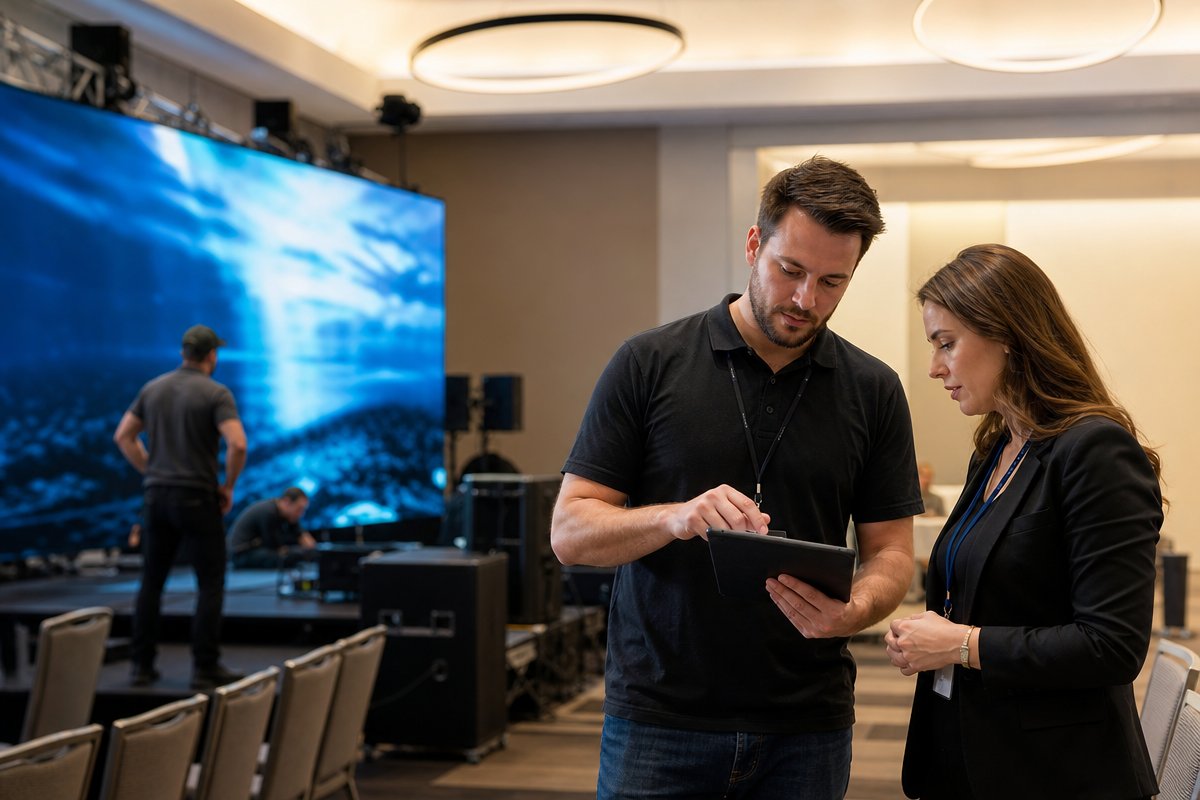
Once your requirements are documented, it is time to evaluate potential providers. Not all audiovisual companies serving Northern Virginia are built the same. Some are national rental houses that ship equipment and hire freelance labor. Others are regional production firms with in-house teams and deep local venue knowledge. Here is the framework that separates a true partner from a vendor.

Criterion 1: Local Experience and Venue Knowledge
Northern Virginia has a unique event ecosystem. Venues like the Hilton McLean Tysons Corner, the Ritz-Carlton Tysons Corner, the Fairview Park Marriott, and the National Conference Center in Leesburg each have specific loading dock constraints, rigging points, power limitations, and union or non-union labor rules. An audiovisual company in Northern Virginia that has produced events at your chosen venue before can anticipate problems that an out-of-market provider simply cannot.
Question to ask: ‘How many events have you produced at [venue name] in the past two years, and can you share a reference from one of those clients?’
Criterion 2: Full-Service Capabilities vs. Equipment-Only Rental
There is a critical difference between a company that drops off speakers and a screen versus one that provides end-to-end production – strategy, creative design, show management, technical direction, and on-site engineering. If your event involves multiple breakout rooms, a main stage with IMAG (image magnification), and a livestream, you need a full-service production partner, not a rental catalog.
Question to ask: ‘Do you provide a dedicated technical director and show caller for multi-session events, or is that an additional hire I need to arrange?’
Criterion 3: Equipment Quality and Inventory Ownership
Companies that own their equipment inventory can control quality, maintain gear on a regular cycle, and respond faster to last-minute changes. Companies that sub-rent everything are adding markups and reducing their ability to troubleshoot on the fly.
Question to ask: ‘What percentage of the equipment in this proposal do you own versus sub-rent, and what is your maintenance schedule for LED walls, projectors, and audio consoles?’
Criterion 4: Staffing Model and Crew Expertise
The people operating the equipment matter as much as the equipment itself. In 2026, the AV labor market remains competitive. Companies with full-time, trained technicians deliver more consistent results than those relying exclusively on freelance crews assembled event by event.
Question to ask: ‘Are the lead audio engineer and video engineer on this event full-time members of your team, or are they freelancers? How do you ensure quality if they are freelancers?’
Criterion 5: Pre-Production Process and Communication
A reliable AV partner does not just show up on event day. They conduct site visits, attend planning meetings, produce detailed technical drawings and signal flow documents, and schedule advance testing. The depth of their pre-production process is a direct indicator of how smooth your event will run.
Question to ask: ‘Walk me through your pre-production timeline from contract signing to load-in. What deliverables will I receive, and when?’
Criterion 6: Insurance, Redundancy, and Contingency Planning
Professional-grade events require backup plans. What happens if a projector lamp fails mid-presentation? What if the internet connection drops during a hybrid session? Top-tier AV companies build redundancy into their proposals – backup switchers, redundant internet connections, spare microphones – and carry comprehensive liability insurance.
Question to ask: ‘What redundancy is built into this proposal, and can you provide a certificate of insurance naming our organization and venue as additionally insured?’
Step 3: Compare Proposals with a Weighted Scorecard
After receiving proposals from three to five audiovisual companies, resist the urge to simply compare bottom-line pricing. Instead, use a weighted scorecard that reflects your priorities. Here is a sample scoring model:
- Local venue experience (20%): Have they worked your venue? Do they know the load-in process and technical infrastructure?
- Full-service capability (20%): Can they handle creative, technical, and management under one roof?
- Equipment quality and ownership (15%): Do they own current-generation gear?
- Staffing model (15%): In-house crew vs. freelance? Crew-to-room ratio?
- Pre-production process (15%): Site visit included? Technical drawings? Advance testing?
- Pricing transparency (15%): Line-item detail? Clear labor vs. equipment breakdown? Overtime policy?
Score each company on a 1–5 scale per criterion, multiply by the weight, and total the results. This removes emotion from the decision and gives you a defensible recommendation to present to stakeholders.

Step 4: Red Flags That Should Disqualify an AV Provider
Even with a scorecard, some warning signs should prompt immediate disqualification regardless of price or personality:
- No site visit offered: Any reputable audiovisual company in Northern Virginia will insist on walking the venue before finalizing a proposal. If they skip this step, they are guessing – and your event will pay the price.
- Vague proposals: If a proposal lists ‘sound system’ without specifying speaker model, quantity, placement, and processing, it is impossible to hold them accountable for quality.
- No references or portfolio: A company that cannot provide three to five references from similar events in the past 12 months is either too new or has something to hide.
- Pressure to sign immediately: Professional AV firms understand procurement timelines. High-pressure tactics signal desperation, not demand.
- No contingency language: If the contract does not address equipment failure, weather delays (for outdoor events), or force majeure, you are exposed to unnecessary risk.
Step 5: The Northern Virginia AV Market in 2026
The Northern Virginia market has evolved significantly. With the continued expansion of corporate headquarters along the Dulles Corridor, the growth of government contracting events in Arlington and Fairfax, and the post-pandemic maturation of hybrid event technology, the demand for sophisticated AV production has never been higher.
Trends Shaping AV Decisions in 2026
- LED walls replacing projection: Indoor LED video walls now offer superior brightness, color accuracy, and flexibility compared to traditional projection in many Northern Virginia venue environments – especially spaces with ambient light challenges.
- Hybrid as standard: Streaming a live event to remote attendees is no longer a pandemic workaround. It is an expected deliverable that requires dedicated cameras, encoding hardware, and a separate production workflow.
- Sustainability requirements: Many corporate clients in the DMV now require vendors to demonstrate sustainable practices – energy-efficient LED lighting, reduced truck rolls through local warehousing, and reusable scenic elements.
- AI-enhanced production: Automated camera tracking, real-time captioning, and AI-assisted audio mixing are entering mainstream event production, and forward-thinking AV companies are integrating these tools into their service offerings.
When evaluating providers, ask how they are adapting to these trends. Their answer reveals whether they are investing in the future or coasting on outdated workflows.
Frequently Asked Questions
How far in advance should I book an audiovisual company in Northern Virginia?
For large corporate events, conferences, and galas, booking 8 to 12 weeks in advance is recommended. For peak seasons – spring (March through May) and fall (September through November) – in the Northern Virginia market, 12 to 16 weeks is safer. Smaller meetings may require less lead time, but early booking ensures you get your preferred crew and equipment.
What is the average cost of AV production for a corporate event in Northern Virginia?
Costs vary widely based on scope. A single-room corporate meeting with a screen, projector, and basic audio might range from $2,500 to $7,500. A multi-day conference with main stage production, breakout rooms, LED video walls, and livestreaming can range from $25,000 to $150,000 or more. The key is ensuring proposals include detailed line items so you understand exactly what drives the total.
Should I use the in-house AV provider at my Northern Virginia venue or hire an outside company?
In-house providers offer convenience but often come with higher markups on equipment and limited flexibility on creative solutions. An outside audiovisual company in Northern Virginia with experience at your venue can frequently deliver higher production value at a comparable or lower cost – especially for complex, multi-element events. Always request proposals from both and compare using the scorecard framework above.
What is the difference between AV rental and full-service event production?
AV rental means you receive equipment – speakers, screens, microphones – and are responsible for setup, operation, and troubleshooting. Full-service event production includes strategic planning, creative design, technical engineering, equipment, on-site crew, show management, and post-event support. If your event has any degree of complexity, full-service production dramatically reduces your risk and stress.
How do I verify that an AV company is properly insured?
Request a current certificate of insurance (COI) that includes general liability coverage of at least $1 million per occurrence, workers’ compensation coverage for all on-site crew, and the ability to name your organization and venue as additionally insured. Any professional company will provide this within 24 to 48 hours of your request.
Can one AV company handle audio, video, lighting, staging, and streaming for a single event?
Yes – and ideally, they should. Working with a single full-service provider eliminates coordination gaps between multiple vendors, reduces finger-pointing when issues arise, and ensures all technical systems are designed to work together from the start. This integrated approach is especially important for high-visibility events where there is no room for error.
Make Your Next Event Flawless with the Right AV Partner
Finding the right audiovisual company in Northern Virginia is not about picking the cheapest bid or the flashiest website. It is about applying a disciplined evaluation framework that accounts for local expertise, full-service capability, equipment quality, crew reliability, pre-production rigor, and contingency planning. Use the scorecard approach outlined above, ask the hard questions, and you will make a decision you can defend with confidence.
TriVision Event Production has served corporate and organizational clients across Washington DC, Northern Virginia, and Maryland for over 30 years. From audio and lighting design to LED video walls, staging, creative strategy, and show management, TriVision delivers end-to-end production for complex, high-visibility events. If you are planning an event in the Northern Virginia corridor and want a partner – not just a vendor – visit TriVision Event Production to start the conversation.
Let’s talk about your event
Tell us the date and the room - we’ll bring the plan.