
Quick answer: Association event production in DC rests on five core elements every board member should understand: audio, LED walls and projection, lighting design, staging and scenic design, and show management. The most costly board-level mistakes are treating AV as a last-minute add-on, defaulting to in-house hotel AV, underbudgeting production relative to the event’s revenue role, and skipping the pre-event site visit.
Your Association Deserves More Than a Ballroom and a Podium

If you serve on an association board in the nation’s capital, you already know the stakes. Your annual conference, advocacy gala, or membership meeting isn’t just an event – it’s the single most visible expression of your organization’s credibility, mission, and momentum. Yet the challenge association leaders voice most often is the same one: delivering increasingly sophisticated event experiences while managing tighter budgets. That tension is exactly why association event production in Washington DC has evolved from a nice-to-have line item into a strategic imperative for boards in 2026.
Washington DC is home to more than 4,000 trade and professional associations, making it the most competitive market in the country for membership engagement. Whether you’re planning a 3,000-attendee annual meeting at the Walter E. Washington Convention Center or an intimate advocacy reception on Capitol Hill, the production quality of your event directly shapes how members, sponsors, and policymakers perceive your organization. This guide is written specifically for board members and association executives who need to understand what professional event production looks like, why it matters, and how to make smarter decisions for 2026 and beyond.

Why Association Events in DC Demand a Higher Production Standard

The DC Audience Is Uniquely Discerning
Association events in Washington DC don’t happen in a vacuum. Your attendees are policy professionals, C-suite executives, government officials, and industry thought leaders who attend dozens of high-caliber events each year. They’ve experienced world-class keynotes at the National Building Museum, polished galas at the Marriott Marquis, and broadcast-quality panels at venues across the DMV region. Their expectations are calibrated accordingly.
When your general session features a dim projector, inconsistent audio, or a generic pipe-and-drape stage, it doesn’t just look bad – it quietly undermines your organization’s authority. Conversely, when your event features crisp LED video walls, immersive lighting design, and disciplined show management, it sends a powerful signal: this association is professional, relevant, and worth investing in.
Sponsorship Revenue Depends on Production Value
For most associations, event sponsorship represents a significant revenue stream. In 2026, sponsors are more sophisticated than ever. They want branded digital signage, high-visibility logo placements on LED screens, and polished stage environments that showcase their investment. A well-produced event gives your sponsorship sales team tangible, visual proof of ROI – and that translates directly into higher renewal rates and premium pricing tiers.
- Branded LED content: Dynamic sponsor logos and messaging displayed on high-resolution screens throughout the venue
- Custom stage design: Scenic elements that incorporate sponsor branding without looking cluttered
- Live-stream integration: Professional video production that extends sponsor visibility to virtual attendees
- IMAG (image magnification): Camera work that captures sponsor signage during keynotes and panels
The Five Core Production Elements Every Board Member Should Understand
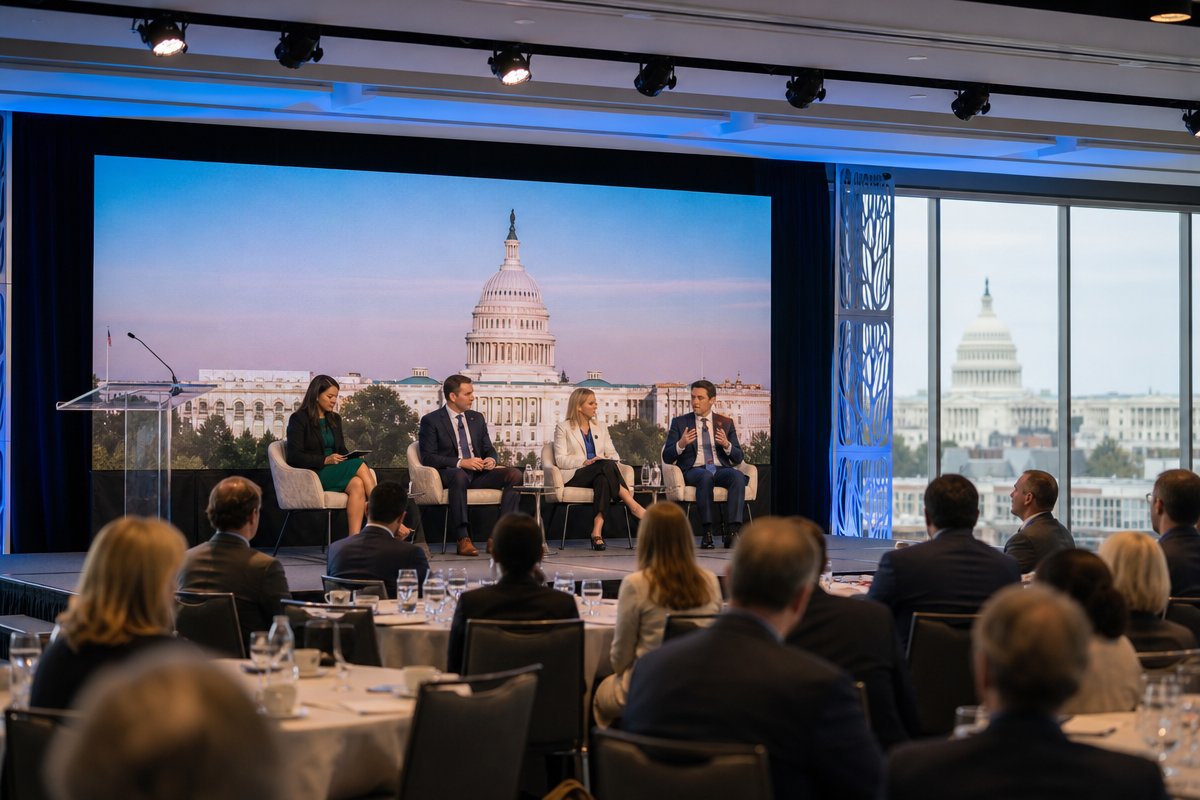
You don’t need to become a technical expert, but as a board member approving budgets and setting event strategy, understanding these five pillars of association event production in Washington DC will help you ask better questions and make more informed decisions.
1. Audio Solutions
Audio is the single most important – and most frequently underestimated – element of event production. If your audience can’t hear a speaker clearly, nothing else matters. Professional audio engineering involves far more than placing speakers on stands. It requires room analysis, microphone selection (lavalier, handheld, podium), monitor mixing for presenters, and real-time adjustments throughout the program.
For association events with breakout sessions across multiple rooms, a coordinated audio plan ensures consistent quality in every space – not just the main ballroom.
2. LEDs, Projections & Monitors
LED video walls have become the visual centerpiece of modern association events. They offer superior brightness, uniform edge-to-edge image quality, and the flexibility to display keynote slides, live camera feeds, pre-produced video content, and sponsor messaging – all on a single surface. For large general sessions, LED walls eliminate the washed-out look that projectors often produce in venues with ambient light.
Board members should understand pixel pitch (the resolution density of an LED wall) and how it affects viewing distance and image clarity. A reputable production partner will recommend the right panel configuration based on your venue dimensions and audience size.
3. Lighting Design
Lighting sets the emotional tone of every moment in your event. A skilled lighting designer creates distinct looks for different program segments – energetic washes for networking receptions, focused spotlights for keynote addresses, dramatic color palettes for awards galas. Intelligent lighting can also reinforce your association’s brand colors throughout the venue, creating a cohesive visual identity.
4. Staging & Scenic Design
Your stage is the focal point of your event. Custom scenic design – including set pieces, backdrops, branded elements, and riser configurations – transforms a generic hotel ballroom into a purpose-built environment that reflects your association’s identity. In 2026, the trend is moving toward modular scenic elements that combine physical structures with digital surfaces for maximum visual impact.
5. Show Management & Technical Direction
This is the behind-the-scenes orchestration that makes everything run on time, on brand, and without visible problems. A technical director manages cue-to-cue execution, coordinates with venue staff, handles speaker walk-throughs, and ensures that every transition – from video roll-ins to award presentations – happens flawlessly. For association events with complex run-of-shows, this role is indispensable.

Association Event Production Washington DC: Common Mistakes Boards Make
After more than 30 years of producing events in the DMV region, our team at TriVision Event Production has seen patterns in the mistakes that well-intentioned boards and planning committees make. Here are the most consequential ones – and how to avoid them.
Mistake #1: Treating AV as a Last-Minute Add-On
Too many associations select their venue, book their speakers, finalize their agenda, and then think about production. By that point, critical decisions have already been made – room configurations, power availability, rigging points – that may limit what’s possible or drive up costs. Professional event production should be part of the planning process from day one, ideally 4–6 months before the event.
Mistake #2: Defaulting to In-House Hotel AV
Hotel AV departments serve a purpose, but they are rarely equipped to deliver the caliber of production that a major association event demands. In-house packages often come with limited equipment inventories, less experienced technicians, and standardized setups that don’t account for your specific program needs. An independent production company brings specialized expertise, superior equipment, and the creative flexibility to design an experience tailored to your event.
Mistake #3: Underbudgeting Production Relative to the Event’s Importance
If your annual meeting generates $500,000 in sponsorship revenue and drives membership renewals for the coming year, allocating 3% of your budget to production is a strategic miscalculation. For events where the attendee experience is a primary success metric, production deserves a far larger share of the total budget than a token line item.
Mistake #4: Not Requesting a Site Visit with Your Production Partner
Every DC venue has quirks – ceiling height limitations, power distribution challenges, load-in restrictions, union labor requirements. A pre-event site visit with your production partner identifies these issues early and prevents costly surprises during setup.
What to Look for in a DC-Based Event Production Partner
Not all production companies are created equal, and the right partner for a corporate product launch may not be the right partner for an association’s annual conference. Here’s what association board members should prioritize when evaluating production companies in the Washington DC, Northern Virginia, and Maryland market:
- Association-specific experience: Look for a company that has produced events for organizations similar to yours – annual meetings, advocacy events, awards galas, and membership-driven conferences. The operational rhythms of association events are distinct from corporate events.
- Full-service capabilities: A partner that offers audio, video, lighting, staging, scenic design, and show management under one roof simplifies coordination and reduces the risk of communication breakdowns between multiple vendors.
- Local venue knowledge: A DC-based production company will have established relationships with major venues across the region – from the convention center to hotel ballrooms in Arlington, Bethesda, and downtown DC. That institutional knowledge saves time and money.
- Creative and strategic thinking: The best production partners don’t just execute your vision – they enhance it. Look for a team that brings creative ideas for stage design, audience engagement, and content delivery that you hadn’t considered.
- Transparent pricing: Detailed, itemized proposals – not vague packages – allow your board to make informed budget decisions and understand exactly what they’re paying for.

Frequently Asked Questions About Association Event Production in DC
How far in advance should our association book an event production company?
For large-scale annual meetings or galas, we recommend engaging a production partner 4–6 months in advance. This timeline allows for proper site visits, design collaboration, equipment reservation, and technical planning. For smaller events or advocacy receptions, 6–8 weeks is typically sufficient, though earlier is always better – especially during DC’s busy spring and fall event seasons when production companies and equipment inventories are in high demand.
What’s the typical budget range for association event production in Washington DC?
Budgets vary significantly based on event size, venue, and production complexity. A polished general session with professional audio, LED video walls, lighting, and show management for 500–1,000 attendees in a DC ballroom typically ranges from $25,000 to $75,000. Multi-day conferences with breakout rooms, live streaming, and custom scenic elements can range from $75,000 to $200,000+. Your production partner should provide a detailed proposal that aligns with your specific program requirements and budget parameters.
Can a production company help us increase sponsorship revenue?
Absolutely. Professional production creates tangible sponsorship assets – branded LED content, on-screen logo rotations, custom scenic branding, and broadcast-quality live streams – that justify premium sponsorship pricing. Many associations find that investing in higher production value directly increases their ability to attract and retain sponsors, often generating a net positive return on the additional production investment.
Do we need a separate production company if our venue offers in-house AV?
In most cases, yes. In-house AV is designed for standard meeting setups – a projector, a screen, a podium mic. If your event involves keynote presentations, awards ceremonies, live video, complex lighting, or any element that needs to impress your membership and sponsors, an independent production company will deliver a dramatically superior result. Most DC venues allow outside production companies to work in their spaces, though some charge a rigging or power fee.
What is show management, and why does our association need it?
Show management is the professional coordination of every technical and logistical element during your event. A show manager or technical director creates a detailed cue sheet, runs speaker rehearsals, coordinates with venue staff, manages real-time transitions, and serves as the single point of accountability for ensuring your program runs smoothly. For any association event with more than a few agenda items, show management is the difference between a polished experience and a stressful one.
How does hybrid or virtual production work for association events?
Many associations in 2026 continue to offer virtual attendance options for members who can’t travel to DC. Professional hybrid production involves multi-camera video capture, broadcast-quality encoding, platform integration (Zoom, Webex, custom platforms), remote audience engagement tools, and on-site technical monitoring to ensure virtual attendees receive a high-quality experience. This requires specialized equipment and expertise beyond what standard conferencing tools provide.
Plan Your Next Association Event with TriVision Event Production
As a board member or association executive planning events in 2026, you have a choice: deliver a forgettable meeting that blends into DC’s crowded event calendar, or create an experience that energizes your membership, impresses your sponsors, and reinforces your organization’s standing as a leader in your industry.
TriVision Event Production has been the trusted production partner for corporate and organizational clients across Washington DC, Northern Virginia, and Maryland for over 30 years. We specialize in the exact type of high-visibility, mission-critical events that associations produce – annual conferences, advocacy galas, awards ceremonies, and leadership summits. Our full-service capabilities in audio, video, LED walls, lighting, staging, scenic design, and show management mean you get one accountable partner from concept through execution.
If your association is planning an event in the DMV region, we’d welcome the opportunity to discuss how professional association event production in Washington DC can transform your next event. Visit TriVision Event Production to start a conversation with our team today.
Let’s talk about your event
Tell us the date and the room - we’ll bring the plan.