
Quick answer: A complete convention AV checklist for DC covers six areas: audio solutions, LED walls and projection, lighting design, staging and rigging, video production and livestreaming, and show management with technical direction. Select your AV partner 6–12 months out – DC’s calendar is packed and experienced production teams book early – and decide deliberately between venue-provided AV and a full-service production partner.
If you are planning a large-scale convention in the nation’s capital, the audiovisual setup is not just a line item on your budget – it is the backbone of your attendee experience. Convention AV services in Washington DC can make or break an event where thousands of professionals gather, keynotes are livestreamed to global audiences, and sponsors expect polished, high-visibility branding at every turn. The greater Washington DC metro area hosts a packed calendar of major conventions and trade shows every year. With stakes that high, a detailed AV checklist is not optional – it is essential.
Whether you are coordinating a multi-day association summit at the Walter E. Washington Convention Center or a corporate conference at a downtown hotel ballroom, this guide gives you a practical, section-by-section checklist of every AV service you should secure before your event goes live in 2026.

Why a Dedicated AV Checklist Matters for DC Conventions

Washington DC is unlike any other convention market in the country. The city attracts a sophisticated mix of government agencies, national associations, advocacy organizations, and Fortune 500 companies. Attendees and stakeholders expect broadcast-quality production, reliable connectivity, and flawless execution from the moment doors open to the final session close.
Yet many convention planners – even experienced ones – underestimate the complexity of AV logistics at scale. A breakout room’s sound system bleeds into the hallway. A keynote’s LED wall cannot be installed because rigging points were never confirmed with the venue. The livestream drops mid-presentation because bandwidth was shared with the exhibitor hall Wi-Fi.
These are not hypothetical disasters. They happen at conventions every week across the DMV region. A structured checklist ensures that every technical detail is addressed early enough to prevent costly last-minute fixes – or worse, visible failures in front of your most important audiences.
The Difference Between Venue-Provided AV and a Full-Service Partner
Most major DC convention venues offer in-house AV packages. While convenient, these packages are typically designed for general-purpose meetings, not complex, multi-room conventions with simultaneous sessions, live streaming, and custom scenic design. Here is what you should understand:
- Venue AV: Basic microphones, projectors, and screens; limited customization; per-room pricing that can escalate quickly.
- Full-service event production partner: End-to-end design, engineering, and execution tailored to your event’s specific goals, audience size, and branding requirements.
For conventions with more than 500 attendees, multiple stages, or any broadcast component, partnering with a dedicated AV production company is almost always the smarter investment.
Convention AV Services Washington DC: Your Complete Checklist
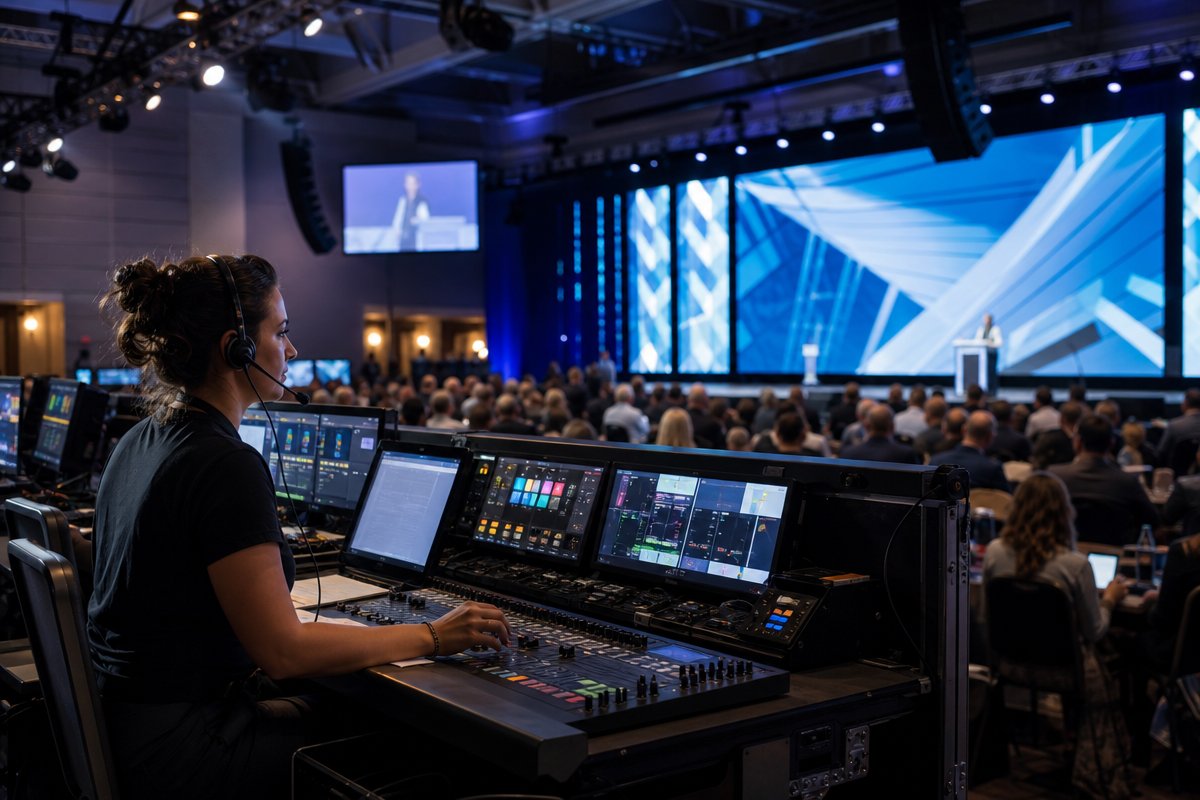
Below is a comprehensive, section-by-section checklist covering every AV service area convention planners should address. Use this as your master planning document when coordinating with your production partner, venue, and stakeholders.
1. Audio Solutions
Sound quality is the single most cited complaint at conventions when it fails – and the least noticed when it succeeds. That is exactly the goal: invisible excellence.
- Main stage PA system: Line array speakers sized appropriately for the room capacity and ceiling height. For a general session of 2,000+ attendees, you need a flown line array, not ground-stacked speakers that block sightlines.
- Breakout room audio: Individual sound systems for each session room, with proper speaker placement to ensure even coverage without bleed into adjacent spaces.
- Wireless microphone systems: Handheld, lavalier, and headset options for presenters. Ensure frequency coordination across all rooms to prevent interference – this is critical in DC where the RF spectrum is congested due to government and media activity.
- Audio mixing and engineering: A dedicated audio engineer for the main stage and roaming techs for breakout rooms.
- Hearing assistance and ADA compliance: Assistive listening devices or hearing loop systems as required by ADA regulations. DC venues often have specific requirements.
- Audio feeds for livestream and recording: Clean board mixes separated from the house mix, specifically optimized for virtual audiences.
2. LED Walls, Projections, and Monitors
Your visual displays communicate your brand, support your speakers, and engage your audience. In 2026, LED technology has become the standard for high-impact convention stages.
- Main stage LED wall: Determine pixel pitch based on viewing distance. For a general session where the closest attendee is 20 feet away, a 2.9mm or 3.9mm pitch LED wall delivers crisp visuals without visible pixelation.
- Confidence monitors: Floor monitors or teleprompters positioned at the stage edge so presenters can see their slides and notes without turning their backs to the audience.
- IMAG (Image Magnification): Large-format side screens displaying live camera feeds of the speaker, essential for any room where the back row is more than 75 feet from the stage.
- Breakout room displays: Projection screens or flat-panel monitors sized for each room. Confirm throw distances and ambient light levels – a projector that works in a dark ballroom will wash out in a room with floor-to-ceiling windows.
- Digital signage and wayfinding: LED or LCD screens in lobbies, hallways, and registration areas displaying schedules, sponsor logos, social media feeds, and directional information.
- Content management: A system for loading, previewing, and switching between presentations, videos, and graphics across all display surfaces.

3. Lighting Design
Lighting does far more than illuminate a stage. It sets the tone, directs attention, reinforces branding, and ensures your video content – both in-room and streamed – looks professional.
- Stage lighting: Front wash, back lighting, and key lighting for presenters. Color temperature matters – warm lighting looks great in person but can cause issues on camera if not balanced.
- Audience lighting: Controlled house lights that can dim for keynotes and brighten for networking segments.
- Breakout room lighting: Adjustable lighting presets for presentations, panel discussions, and interactive workshops.
- Scenic and accent lighting: Uplighting, gobos (custom pattern projections), and color washes that reinforce your event branding throughout the venue.
- Lighting console and operator: A dedicated lighting designer or programmer who can adjust looks in real-time as the event flow changes.
4. Staging, Scenic Design, and Rigging
The physical environment of your convention creates the first impression and the lasting memory. Staging and scenic elements must be designed for both aesthetics and safety.
- Main stage platform: Custom-built staging at the correct height, with proper skirting, stairs, and ADA-compliant ramp access.
- Scenic elements: Branded backdrops, set pieces, fabric treatments, or hard-wall scenic panels that create a cohesive visual identity for your event.
- Rigging and load assessment: Confirm rigging points with the venue for hanging LED walls, speakers, lighting fixtures, and banners. DC convention venues have specific rigging rules and weight limits that must be verified during the advance planning phase.
- Podiums and furniture: Lecterns, panel discussion seating, interview sets, and presenter tables that match your event design.
- Pipe and drape: For dividing large halls into breakout spaces, creating backstage areas, or masking technical equipment.
5. Video Production and Livestreaming
In the post-pandemic era, hybrid and virtual components are now standard for conventions. Even if your event is primarily in-person, there is a strong likelihood that key sessions will be recorded or streamed.
- Multi-camera capture: At minimum, two cameras for the main stage – a wide shot and a close-up of the presenter. Three or more cameras enable dynamic switching with audience shots.
- Livestream encoding and platform management: Professional-grade encoders, redundant internet connections, and a streaming platform that can handle your expected concurrent viewer count.
- Video switching and directing: A technical director operating a video switcher to cut between cameras, slides, pre-recorded video, and graphics in real-time.
- Recording for post-event content: High-quality recordings of all sessions for on-demand access, highlight reels, and social media content.
- Dedicated internet bandwidth: A bonded or dedicated fiber connection separate from the venue’s general Wi-Fi. Never rely on shared convention center Wi-Fi for mission-critical streaming.
6. Show Management and Technical Direction
This is the layer that ties everything together. Without experienced show management, even the best equipment and design will stumble during execution.
- Technical director: A single point of accountability who oversees all AV departments and communicates with your event planning team.
- Show caller or stage manager: The person who cues every element – lights, sound, video, presenter walkups – according to a detailed show flow document.
- Rehearsals and sound checks: Schedule dedicated time for presenter rehearsals, especially for keynotes and award ceremonies. Plan for at least 30 minutes per major presenter.
- On-site technical support: Engineers and technicians stationed in every active room throughout the event, not just during setup.
- Contingency planning: Backup equipment on-site (spare projectors, backup microphones, redundant streaming encoders) and documented protocols for common failure scenarios.
Timeline: When to Secure Convention AV Services
Timing is one of the most common planning mistakes for DC conventions. The city’s event calendar is packed year-round, and experienced production companies book months in advance. Here is a recommended timeline:
- 6–12 months out: Select your AV production partner. Conduct initial site visits. Define scope, budget parameters, and key technical requirements.
- 4–6 months out: Finalize room layouts, stage designs, and equipment lists. Confirm rigging specifications with the venue. Begin content and branding design.
- 2–3 months out: Detailed show flow creation. Coordinate with speakers on presentation formats and technical needs. Schedule rehearsal times.
- 2–4 weeks out: Final technical review with venue and production team. Confirm load-in and load-out schedules. Ship or stage equipment.
- Event week: Load-in, system setup, testing, rehearsals, and execution. Post-event: load-out, content delivery, and debrief.
Key Questions to Ask Your Convention AV Partner
Not all AV companies are equipped to handle large-scale conventions. When evaluating potential partners for your DC event, ask these questions:
- How many conventions of similar scale have you produced in the DC metro area?
- Do you own your equipment, or do you sub-rent? (Ownership means faster troubleshooting and replacements.)
- Will you provide a dedicated technical director for the entire event?
- Can you handle both in-person production and livestream/hybrid components with a single team?
- What is your contingency plan if critical equipment fails during the event?
- Do you have established relationships with major DC convention venues?
Frequently Asked Questions About Convention AV Services in Washington DC
How much do convention AV services cost in Washington DC?
Costs vary significantly based on the scale and complexity of your event. A single-day convention with one main stage and four breakout rooms might range from $25,000 to $75,000 for full AV production. Multi-day conventions with LED walls, livestreaming, custom scenic, and multiple stages can range from $100,000 to $300,000 or more. The best approach is to define your scope first and then request a detailed, line-item proposal from your production partner so you understand exactly what you are paying for.
Should I use the convention center’s in-house AV or hire an outside company?
For small meetings and simple setups, in-house AV can be cost-effective and convenient. For conventions with more than 500 attendees, multiple simultaneous sessions, LED walls, custom staging, or any livestream component, an outside full-service production company will deliver a significantly better result. Outside partners bring specialized expertise, custom design capabilities, and dedicated personnel that in-house teams typically cannot match at convention scale.
How far in advance should I book AV services for a DC convention?
For large-scale conventions, we recommend engaging your AV production partner 6 to 12 months before the event date. Washington DC is one of the busiest convention markets in the United States, and experienced production companies fill their calendars well in advance, especially during peak season from September through November and March through June.
What is the most overlooked AV element at conventions?
Audio quality in breakout rooms is consistently the most overlooked element. Planners focus heavily on the main stage – rightfully so – but attendees spend the majority of their time in breakout sessions. Poor sound in these rooms leads to negative feedback, lower session ratings, and reduced engagement. Every breakout room should have a properly sized sound system, a quality wireless microphone, and a technician available for troubleshooting.
Do I need a separate internet connection for livestreaming?
Absolutely. Convention center Wi-Fi is shared among vendors, exhibitors, and thousands of attendees simultaneously. Relying on it for livestreaming is a recipe for dropped connections and poor video quality. Your AV partner should arrange a dedicated, bonded internet connection – typically a hardwired fiber line – specifically for streaming and video production. This is a non-negotiable item for any convention with a virtual audience.
Can one AV company handle everything, or do I need multiple vendors?
A full-service event production company can – and should – handle audio, video, lighting, staging, scenic, livestreaming, and show management under one roof. Using a single partner eliminates finger-pointing between vendors, simplifies communication, and ensures that all technical elements are designed and tested as an integrated system. This is especially important for complex, multi-room conventions where coordination between departments is critical.
Partner With a Team That Knows DC Conventions Inside and Out
Planning convention AV services in Washington DC requires more than a list of equipment – it demands a production partner with deep experience in the region’s most demanding venues, a team that understands the unique expectations of association, government, and corporate audiences, and the technical depth to execute flawlessly at scale.
TriVision Event Production has been the trusted full-service event production partner for corporate and organizational clients across Washington DC, Northern Virginia, and Maryland for over 30 years. From audio and lighting to LED walls, staging, video production, and show management, our team delivers end-to-end convention production designed for complex, high-visibility events.
Ready to start planning your 2026 convention? Contact TriVision Event Production to schedule a consultation and get a customized AV plan built specifically for your event, your venue, and your audience.
Let’s talk about your event
Tell us the date and the room - we’ll bring the plan.