
Quick answer: Outside AV companies usually deliver more value for mid-size and large events, with more transparent and more negotiable pricing; in-house AV makes sense mainly for small, simple meetings, tight turnarounds, or venues with true exclusivity. Always get a competitive bid – the in-house quote makes a useful benchmark.
You just locked in the perfect venue for your next corporate event in the DC metro area, and now comes the question that quietly determines your entire production budget: do you use the venue’s in-house AV or hire an outside AV company? It sounds like a simple line item, but planners who default to in-house audiovisual services without a competitive bid often pay significantly more than those who price the same scope with independent providers. The debate around in-house AV vs outside AV company isn’t just about cost – it’s about control, quality, flexibility, and the final experience your attendees walk away with.
In this guide, we break down the real differences – the hidden fees, the equipment limitations, the service gaps, and the genuine advantages on both sides – so you can make a confident, fully informed decision for your next event in Washington DC, Northern Virginia, or Maryland.
What Is In-House AV and How Does It Work?
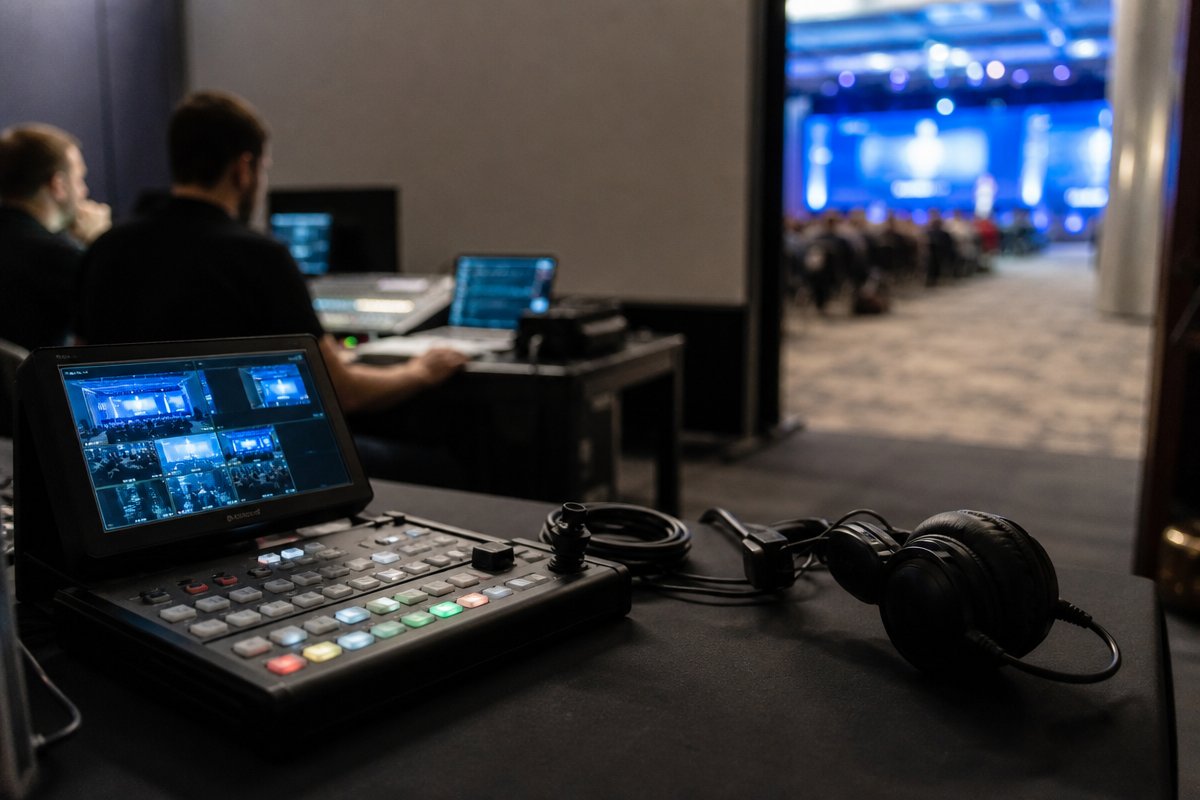
In-house AV refers to the audiovisual equipment and technical staff that a venue – typically a hotel, convention center, or conference facility – provides as part of their event services. Venues contract with a preferred AV provider (or maintain their own internal team) and offer these services to every client who books the space.
The Typical In-House AV Model
Here’s how it usually works in practice across DMV-area venues:
- The venue has an exclusive or preferred AV partner embedded on-site (companies like Encore, PSAV, or similar national providers).
- Basic equipment – a projector, screen, podium microphone, and small speaker setup – is sometimes included in the room rental or offered at a bundled rate.
- Anything beyond the basics (LED walls, advanced lighting, multi-camera video, livestreaming) is quoted as add-ons, often at premium markup rates.
- The in-house team is familiar with the venue’s infrastructure: rigging points, power distribution, loading dock logistics, and room configurations.
Why Venues Push In-House AV
Venues have a financial incentive to keep AV services internal. In-house AV partnerships generate significant revenue through commissions and profit-sharing arrangements. Some venues charge outside vendors additional fees – often labeled as rigging fees, power drops, or labor surcharges – to discourage planners from looking elsewhere. Understanding this dynamic is the first step in making a smarter decision.
What Does Hiring an Outside AV Company Look Like?
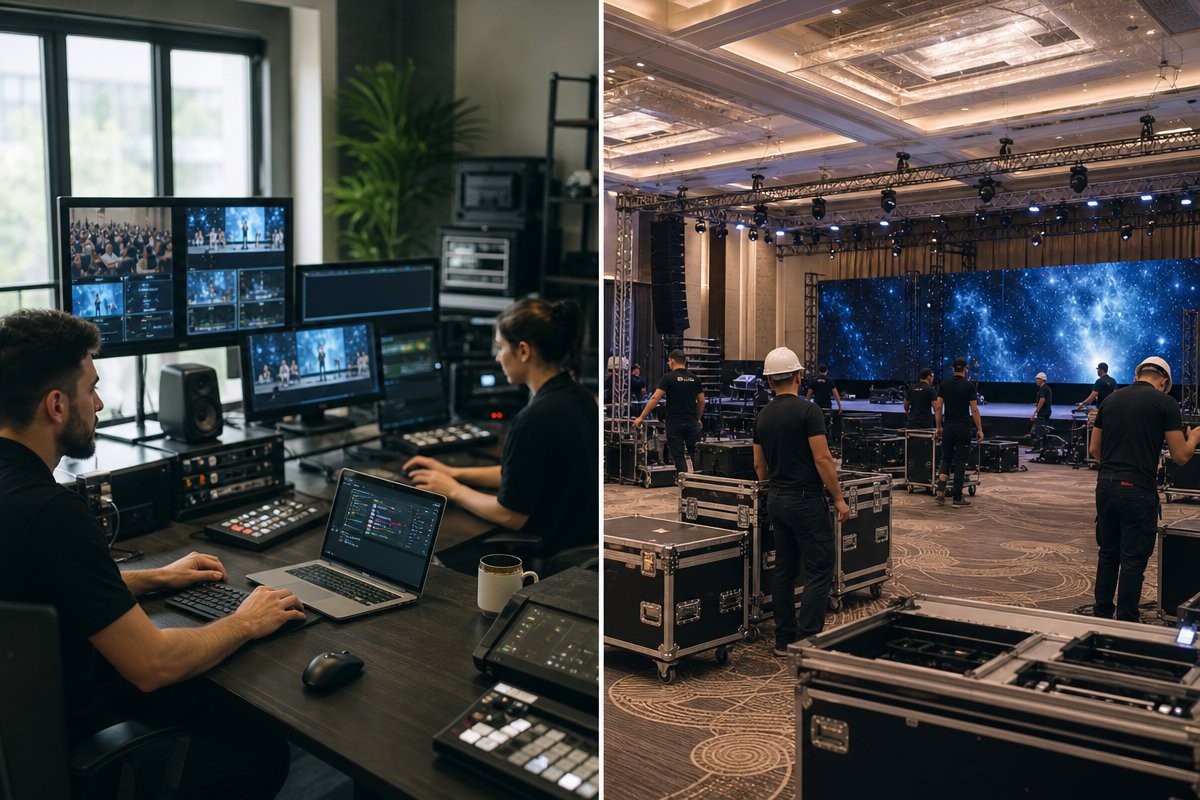
An outside AV company – also called an independent or third-party AV provider – is a production partner you select and hire on your own, independent of the venue. These companies bring their own equipment, technical crew, and creative expertise to your event.
How Independent AV Providers Operate
- You receive a customized proposal based on your specific event goals, audience size, content format, and venue requirements.
- The provider conducts a site visit, coordinates with the venue’s operations team, and plans the full technical production around your vision.
- Equipment is transported to the venue, set up, tested during rehearsals, and operated by dedicated technicians throughout the event.
- After the event, the provider handles teardown and load-out according to the venue’s schedule.
The Growing Preference for Outside AV in 2026
In our experience, corporate event planners in major metro areas increasingly prefer working with independent AV companies for events with more than 200 attendees. The reasons we hear most often are greater equipment quality, creative flexibility, and transparent pricing – all areas where in-house options can fall short.

In-House AV vs Outside AV Company: The True Cost Comparison
Cost is almost always the first factor planners evaluate, so let’s look at where the money actually goes with each option.
Hidden Fees in In-House AV Pricing
In-house AV quotes can appear straightforward, but experienced planners know to look for these common additional charges:
- Labor overtime rates: In-house teams often charge 1.5x to 2x rates for any work outside standard hours – and most events require early morning load-in or late-night teardown.
- Equipment upgrade surcharges: That basic projector included in your package? It may be 5,000 lumens when you need 12,000 for your room size. The upgrade is billed at a steep premium.
- Per-day minimums: Many in-house providers charge full-day rates even for half-day events or rehearsal periods.
- Power and rigging fees: Need to hang speakers from the ceiling or run power to a stage? These utility fees are frequently line items that add up fast.
- Service charges and taxes on AV: Hotels in Washington DC and Maryland commonly apply 20–24% service charges on top of AV invoices, just as they do on catering.
Outside AV Company Pricing: More Transparent, More Negotiable
Independent AV companies typically provide all-inclusive proposals. Here’s what that looks like:
- Bundled packages that include equipment, labor, setup, rehearsal, and teardown in a single price.
- No service charges or commissions layered on top of the quoted price.
- Flexible equipment options – you’re not limited to what’s in the venue’s inventory closet.
- Competitive pricing because independent providers operate in an open market and must earn your business every time.
A Real-World Cost Example
Consider a 500-person corporate conference in a Washington DC hotel with the following needs: dual projection screens, a wireless microphone package for six speakers, stage lighting, confidence monitors, and basic livestreaming.
| Line Item | In-House AV Estimate | Outside AV Estimate |
|---|---|---|
| Projection & Screens | $4,500 | $3,200 |
| Audio Package | $3,800 | $2,600 |
| Lighting | $3,200 | $2,400 |
| Livestreaming | $5,000 | $3,500 |
| Labor & Setup | $4,000 | $3,000 |
| Service Charge (22%) | $4,510 | $0 |
| Total | $25,010 | $14,700 |
That’s a potential savings of over $10,000 – and the outside AV company in this scenario is delivering newer equipment, a dedicated project manager, and a more customized production design.
Quality, Equipment & Creative Flexibility: Where In-House AV Falls Short
Cost aside, the quality of your AV production directly shapes attendee perception. A dim projector, a crackling microphone, or washed-out stage lighting tells your audience that the event wasn’t worth investing in – even if the content is exceptional.
Equipment Age and Availability
In-house AV providers must serve every event in the venue simultaneously. That means:
- Equipment is shared across multiple ballrooms and meeting rooms, so the best gear may already be allocated to another event on the same day.
- Capital equipment cycles are longer – some venues operate projectors and audio consoles that are 5–8 years old.
- Specialty items like LED video walls, moving head lighting fixtures, and 4K camera packages may not be available at all and must be subcontracted – at additional cost to you.
Creative Freedom and Custom Production Design
An independent AV partner works for you, not the venue. This distinction matters enormously when your event requires:
- Custom stage designs with scenic elements, branded LED content, and theatrical lighting.
- Multi-camera IMAG (image magnification) with live switching for keynote presentations.
- Hybrid event production with professional broadcast-quality streaming.
- Interactive audience engagement technology like live polling displays or LED touch walls.
In-house teams are often structured around standard setups – podium, screen, mic – and any deviation becomes an upcharge or a logistical challenge they may not be equipped to handle.

When In-House AV Actually Makes Sense
To be fair, there are situations where using the venue’s in-house AV is the practical and even preferred choice. Being honest about these scenarios helps you make the right call for your specific event.
Small, Simple Meetings
If your event is a 30-person board meeting that requires a screen, a projector, and a couple of table microphones, in-house AV is often the most efficient option. The setup is minimal, the equipment is already on-site, and the cost difference between in-house and outside is negligible.
Tight Turnaround Events
When you have less than a week to plan and the venue has availability, in-house AV eliminates the logistical complexity of coordinating with an outside provider. Speed and convenience win.
Venue-Mandated Exclusivity
Some venues in the DC area have exclusive AV contracts that prohibit or heavily penalize outside vendors. In these cases, you may need to negotiate within the in-house framework or choose a different venue entirely – which is a critical consideration during venue selection.
How to Negotiate and Navigate the Decision
Whether you choose in-house or independent AV, negotiation is key. Here’s how to protect your budget and your event quality.
Questions to Ask Your Venue
- Is outside AV permitted, and are there any additional fees for bringing in a third-party provider?
- What equipment is included in the base room rental versus what’s an add-on?
- Can you provide a detailed, itemized AV quote (not just a bundled total)?
- What are the overtime labor rates, and when do they kick in?
- Is there a required power or rigging fee for outside vendors?
Questions to Ask an Outside AV Company
- Have you worked at this specific venue before?
- Is your quote all-inclusive – labor, setup, teardown, and transport?
- What happens if equipment fails during the event? Do you carry backup gear on-site?
- Will you assign a dedicated project manager and technical director to our event?
- Can you coordinate directly with the venue’s operations team on logistics?
Pro Tip: Use the In-House Quote as a Benchmark
Always request the in-house AV quote first, even if you plan to hire outside. This gives you a detailed baseline for comparison and negotiation leverage. An experienced outside AV company will review the in-house quote line by line and show you where they can deliver equal or better value.
Frequently Asked Questions
Is it always cheaper to hire an outside AV company?
Not always, but in the majority of mid-to-large events (100+ attendees), outside AV companies deliver more value per dollar. The savings become especially significant when your event requires anything beyond basic projection and microphones – LED walls, professional lighting, livestreaming, or multi-room audio distribution. In-house AV may be more cost-effective for very small meetings with minimal technical needs.
Will the venue charge extra fees if I bring in an outside AV company?
Many venues do charge ancillary fees for outside AV providers, including power drop fees, rigging access fees, or general labor surcharges. These fees typically range from $500 to $3,000 depending on the venue and event complexity. However, even with these additional fees factored in, outside AV often remains the more economical option for larger productions. Always ask about these fees during venue contract negotiations – before you sign.
How do I know if the in-house AV equipment will be good enough for my event?
Request a detailed equipment list from the in-house provider, including specific makes, models, and lumen counts for projectors. Compare these specs against your room size, audience count, and content requirements. If you’re unsure, ask an independent AV consultant or production company to review the list. Common red flags include older projector models with low lumen output, limited wireless microphone frequencies, and no LED wall options.
Can I use in-house AV for basics and bring in an outside company for specialty items?
Yes, this hybrid approach is common and can be effective. For example, you might use the venue’s built-in ceiling speakers and basic screens for breakout rooms while hiring an outside company for the main stage LED wall, lighting design, and livestream production. The key is ensuring both teams communicate effectively and that the venue permits this arrangement without excessive fees.
What should I prioritize – cost savings or production quality?
The answer depends on your event’s purpose and audience expectations. For a high-visibility annual conference, a product launch, or a fundraising gala where attendee experience directly impacts outcomes, production quality should lead the decision. For routine internal meetings, cost efficiency is often the smarter priority. The good news is that hiring an outside AV company frequently delivers both better quality and lower cost simultaneously.
How far in advance should I book an outside AV company for a DC-area event?
For events in Washington DC, Northern Virginia, and Maryland, we recommend booking your AV production partner 8–12 weeks in advance for mid-size events and 4–6 months ahead for large-scale conferences or galas. The DMV event market is highly active year-round, and top-tier production companies book quickly, especially during peak association and conference seasons in spring and fall.
Make the Smart AV Decision for Your Next Event
The debate between in-house AV vs outside AV company ultimately comes down to three factors: the complexity of your event, the quality your audience expects, and the transparency you demand from your budget. For simple, small-scale meetings, in-house AV can be perfectly adequate. But for any event where production quality matters – where your brand is on stage, your speakers need confidence, and your attendees need to be engaged – an independent AV partner almost always delivers superior results at a more competitive price.
TriVision Event Production has been the trusted outside AV and event production partner for corporate, association, and organizational clients across Washington DC, Northern Virginia, and Maryland for over 30 years. We specialize in end-to-end production for complex, high-visibility events – from LED video walls and professional lighting to livestreaming and full show management. We’ll even review your in-house AV quote and show you exactly where we can do better.
Ready to compare? Contact TriVision Event Production today for a complimentary consultation and customized proposal for your next event. Let’s build something your audience will remember.
Let’s talk about your event
Tell us the date and the room - we’ll bring the plan.