
Quick answer: Vet a DC AV company on eight points: DC-specific venue experience, full scope of services, equipment inventory and condition, case studies and references, project management process, pricing transparency, insurance and safety standards, and cultural fit. The framework below gives you the questions to ask at each step.
Selecting an AV company in DC can feel like navigating a crowded marketplace blindfolded. The Washington DC metro area hosts thousands of conferences, galas, and corporate events every year, and nearly every one of them depends on audiovisual technology to deliver its message. Yet unreliable AV vendor performance remains one of the most common pain points planners describe. Whether you sit on a procurement team vetting vendors for a federal conference or you are an event manager planning a high-profile association gala, having a structured evaluation process separates a flawless production from a costly disaster.
This post gives you a practical, eight-step vetting framework you can apply immediately. Print it, share it with your committee, and score every prospective AV partner before signing a single contract.
Why a Formal Vetting Process Matters for AV in DC
Washington DC is not a typical event market. The stakes are higher, the audiences are more discerning, and the logistics are more complex than almost anywhere else in the country. From secure government venues with strict load-in protocols to landmark hotels with union labor rules, the variables multiply fast.
Choosing the wrong audiovisual partner does not just mean a fuzzy projector image. It can mean:
- A keynote speaker whose microphone cuts out in front of 1,200 attendees
- LED walls that arrive in the wrong pixel pitch for your room size
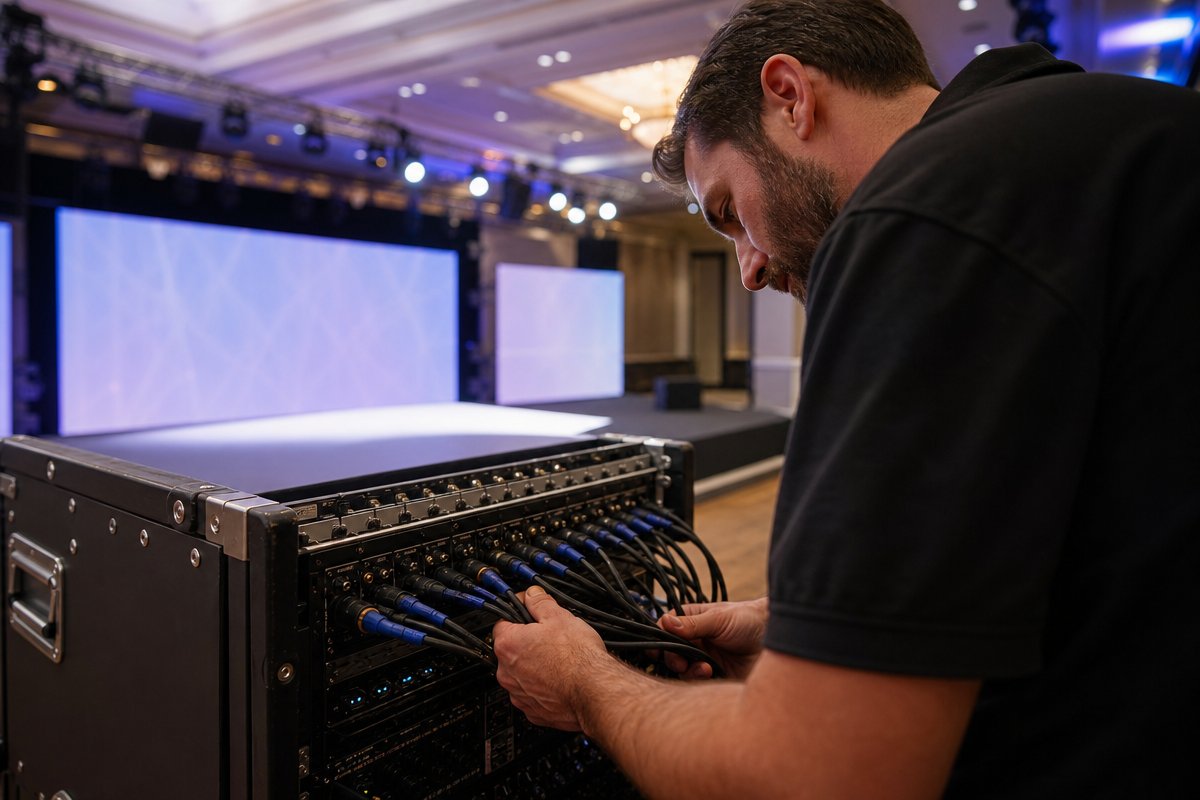
- A crew that has never navigated the freight elevators at your chosen venue
- Change orders that inflate your final invoice by 30 percent or more
A structured vetting process protects your budget, your timeline, and your reputation. Below are eight criteria – organized in the order you should evaluate them – that will help you shortlist the right AV company in DC with confidence.
Step 1: Verify DC-Specific Experience and Venue Knowledge
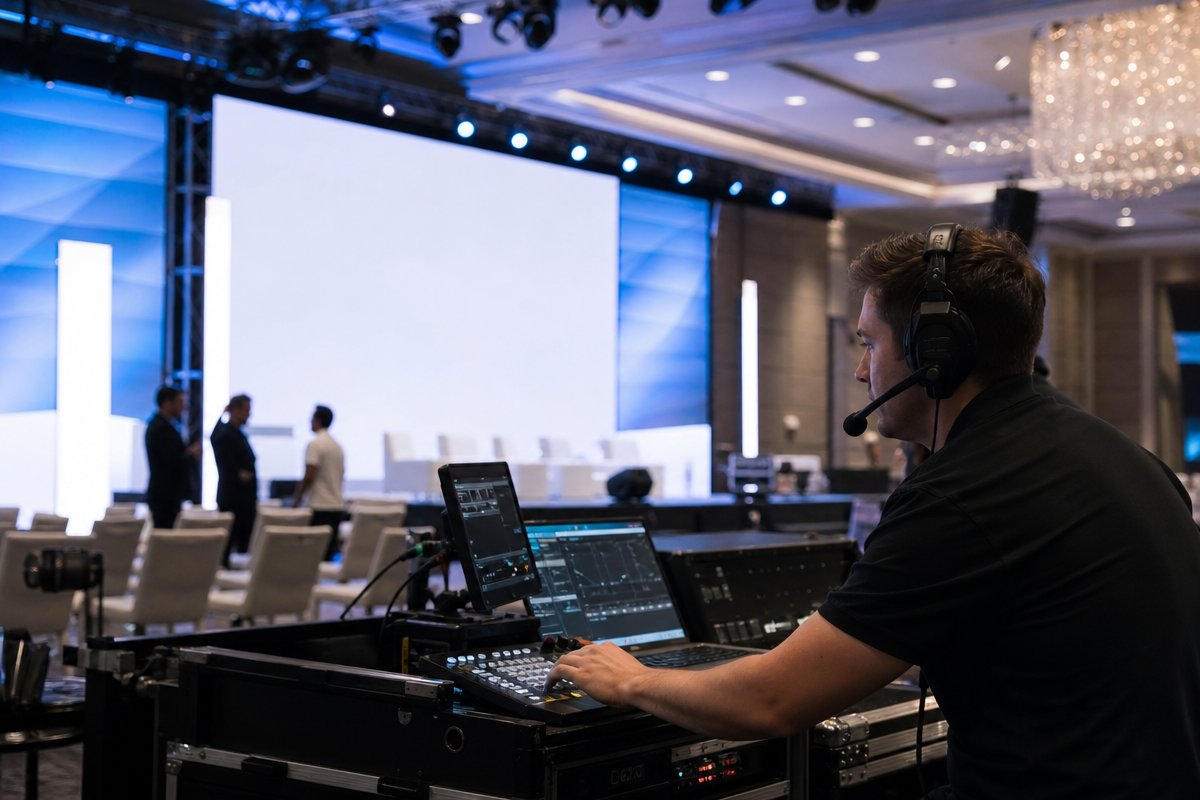
The first filter is local expertise. An AV company may have a polished website and a portfolio full of events in other cities, but DC venues have unique requirements. The Ronald Reagan Building, Walter E. Washington Convention Center, and dozens of hotels in the District each have their own power capacity limits, rigging points, loading dock schedules, and noise ordinances.
Questions to Ask
- How many events have you produced at [your specific venue] in the past two years?
- Can you walk us through load-in logistics for that venue, including union requirements?
- Do you maintain relationships with venue technical directors in the DC, Northern Virginia, and Maryland corridor?
A company with 30-plus years of regional experience – like TriVision Event Production – will answer these questions from memory, not from a Google search.
Step 2: Evaluate the Full Scope of Services
Many AV vendors specialize in one discipline: they rent speakers, or they own a few LED panels. But complex, high-visibility events need integrated solutions. When audio, video, lighting, staging, and show management come from separate vendors, accountability fragments and finger-pointing begins the moment something goes wrong.
Core Services to Confirm
- Audio solutions – microphones, line arrays, distributed speaker systems, hearing-assist compliance
- Video solutions – cameras, switching, IMAG, live streaming, recording
- LEDs, projections, and monitors – indoor and outdoor LED walls, projection mapping, confidence monitors
- Lighting design – stage lighting, architectural washes, intelligent fixtures, gobos
- Staging and scenic – custom stage builds, scenic fabrication, pipe and drape, set design
- Strategy and creative – content design, motion graphics, presentation support
- Show management – technical directors, stage managers, cue-to-cue rehearsals
If one company can deliver all seven under a single project manager, you eliminate coordination gaps and reduce risk dramatically.
Step 3: Inspect Equipment Inventory and Condition
Renting from a company that owns its own equipment versus one that sub-rents everything affects pricing, availability, and quality control. Ask to see – or at minimum, ask about – their inventory.
Red Flags
- Vague answers about equipment brands or models
- Inability to provide a backup plan if a primary unit fails on-site
- No warehouse or staging facility in the DMV region (long trucking distances add cost and risk)
Green Flags
- A local warehouse where you can schedule a pre-event walkthrough or equipment demo
- Current-generation LED panels (sub-2.5mm pixel pitch for indoor corporate use)
- Redundancy protocols: backup switchers, spare wireless microphone frequencies, UPS battery systems
Step 4: Review Case Studies and Client References
Portfolios tell you what a company wants you to see. References tell you what actually happened behind the scenes. Request at least three references from events of similar scale and type to yours – ideally within the past 12 months.
What to Ask References
- Did the AV team meet load-in and load-out schedules without delays?
- How did they handle an unexpected technical issue during the live event?
- Was the final invoice consistent with the original proposal?
- Would you hire them again without hesitation?
In the DC market, many organizations rely on peer recommendations through groups like MPI Potomac, ASAE, and PCMA Capital Chapter. A strong AV company in DC will have a visible presence in these communities.
Step 5: Assess the Project Management and Communication Process
Technical skill means nothing if the communication process is chaotic. During the proposal phase, pay close attention to how quickly and clearly the company responds. This is a preview of what on-site communication will look like.
Benchmarks for Professional Project Management
- Dedicated project manager assigned from proposal through post-event wrap
- Advance site visit offered (not just available on request – proactively recommended)
- Detailed production schedule with load-in, rehearsal, show, and strike timelines
- Technical rider or AV plot provided before the event, not improvised on-site
- Post-event debrief to capture lessons learned for future engagements
Companies that treat project management as a line-item service – not an afterthought – will protect your event from the chaos that underprepared vendors invite.
Step 6: Scrutinize the Proposal and Pricing Transparency
A professional AV proposal should read like a blueprint, not a mystery novel. Every line item should be clear: what equipment, how many units, how many labor hours, and what contingency is built in.
Common Pricing Traps to Watch For
- Bundled pricing with no breakdowns – You cannot negotiate what you cannot see.
- Missing labor categories – Setup, strike, and show-day labor should be listed separately.
- No mention of power or rigging – These can add thousands if discovered late.
- Vague ‘miscellaneous’ or ‘handling’ fees – Ask for specifics.
- No cancellation or change-order policy – In 2026, flexibility clauses are standard practice; their absence is a red flag.
Request proposals from at least three qualified companies to establish a baseline, but remember: the lowest bid is rarely the best value when your organization’s reputation is on the line.

Step 7: Confirm Insurance, Licensing, and Safety Standards
This step is non-negotiable, especially in the DC area where government and association events require proof of adequate coverage.
Minimum Requirements
- General liability insurance (typically $1M per occurrence / $2M aggregate minimum)
- Workers’ compensation coverage for all on-site crew
- Equipment insurance that covers damage during transport and setup
- Compliance with OSHA rigging and electrical safety standards
- Familiarity with ADA requirements for assisted listening devices and captioning
Ask for certificates of insurance upfront. Any AV company in DC that hesitates to provide these documents should be removed from your shortlist immediately.
Step 8: Evaluate Cultural Fit and Long-Term Partnership Potential
This final step is the most subjective – but arguably the most important for organizations that host recurring events. The best AV partnerships are built on trust, institutional knowledge, and shared standards of excellence.
Indicators of a Strong Cultural Fit
- The team asks about your organizational goals, not just your equipment list
- They offer creative suggestions that improve the attendee experience
- They are willing to attend planning meetings alongside your internal stakeholders
- They invest time in understanding your brand guidelines, messaging, and audience demographics
- They think beyond the current event and help you build a multi-year production strategy
When you find a partner that treats your event like their own, the ROI compounds year after year. Institutional knowledge of your preferences, your venues, and your audience means faster planning cycles, fewer surprises, and consistently better results.
Frequently Asked Questions
How far in advance should I book an AV company in DC?
For large-scale corporate or association events, aim to secure your AV partner at least three to four months in advance. During peak conference season – typically September through November and March through May – DC-area AV companies book quickly. For events at high-demand venues like the Walter E. Washington Convention Center, six months of lead time is advisable to ensure equipment availability and preferred crew scheduling.
What is the typical budget range for AV services at a DC corporate event?
Budgets vary widely depending on scope. A straightforward meeting with a single screen and basic audio for 100 attendees might start around $3,000 to $5,000. A multi-day conference with LED walls, IMAG cameras, professional lighting, and live streaming can range from $25,000 to $100,000 or more. The best approach is to share your goals and let a qualified AV company provide a detailed proposal so you can make informed decisions rather than guessing.
Should I choose a national AV company or a regional one based in the DC area?
Regional companies that operate primarily in the DC, Northern Virginia, and Maryland corridor often deliver stronger value for events in this market. They maintain local warehouses, have established relationships with venue staff, understand union labor rules, and can respond faster to last-minute changes. National companies may offer brand recognition, but the on-the-ground expertise of a seasoned regional partner like TriVision Event Production frequently outweighs that advantage.
What happens if equipment fails during my event?
Reputable AV companies build redundancy into their production plans. This includes backup wireless microphone frequencies, spare projector lamps or LED panels, redundant audio feeds, and on-site technical staff trained to troubleshoot in real time. During your vetting process, ask specifically about their redundancy protocol – it is one of the clearest indicators of a professional operation versus a budget rental house.
Can one AV company handle both the in-person and virtual components of a hybrid event?
Yes, and in fact, using a single provider for both is strongly recommended. Hybrid events require tight integration between the in-room AV experience and the virtual broadcast. When one team manages cameras, audio feeds, switching, streaming encoders, and the on-site presentation simultaneously, the result is a single, coherent show for both audiences. Fragmented vendor responsibility is one of the leading causes of hybrid event failures.
Put Your Vetting Process to Work
Finding the right AV company in DC does not have to be overwhelming. By following this eight-point framework – from verifying local venue expertise to evaluating cultural fit – you transform a subjective decision into a structured, defensible selection process that your procurement team, board, or planning committee can stand behind.
TriVision Event Production has served corporate and organizational clients across Washington DC, Northern Virginia, and Maryland for over 30 years. From audio and lighting to LED walls, staging, and full show management, TriVision delivers end-to-end event production for complex, high-visibility events throughout the DMV region.
Ready to put this vetting process to the test? Visit TriVision Event Production to start a conversation about your next event. Let us show you what three decades of DC-area expertise looks like in action.
Let’s talk about your event
Tell us the date and the room - we’ll bring the plan.