
Quick answer: Professional AV production in Washington DC moves through five phases: pre-production planning (site survey, technical design, show flow), load-in and build, rehearsal and sound check, showtime execution with a full crew working behind the scenes, and strike and load-out after the applause. The polish your audience experiences on show day is engineered in the phases they never see.
You have a keynote in six hours. The ballroom is empty. Crates are stacked on the loading dock, cables are coiled on carts, and a crew in black shirts is already mapping out sight lines. By the time your first attendee walks through the door, every microphone will be tested, every screen will be calibrated, and every lighting cue will be programmed – but right now, it looks like organized chaos. That gap between an empty venue and a flawless event is exactly where professional audiovisual services in Washington DC prove their value. In a city like DC – where every gala, conference, and association summit carries reputational stakes – the quality of your AV partner isn’t a line item. It’s the difference between a forgettable meeting and an event people mention weeks later.
This post takes you behind the scenes. We’re walking through what actually happens when a professional AV production team transforms a Washington DC venue from bare walls to broadcast-ready – hour by hour, phase by phase. Whether you’re a meeting planner, an executive assistant coordinating a leadership summit, or an association director planning your annual conference, this is what you should expect from a team that does this work at the highest level.

Phase One: Pre-Production Planning Before the Truck Arrives
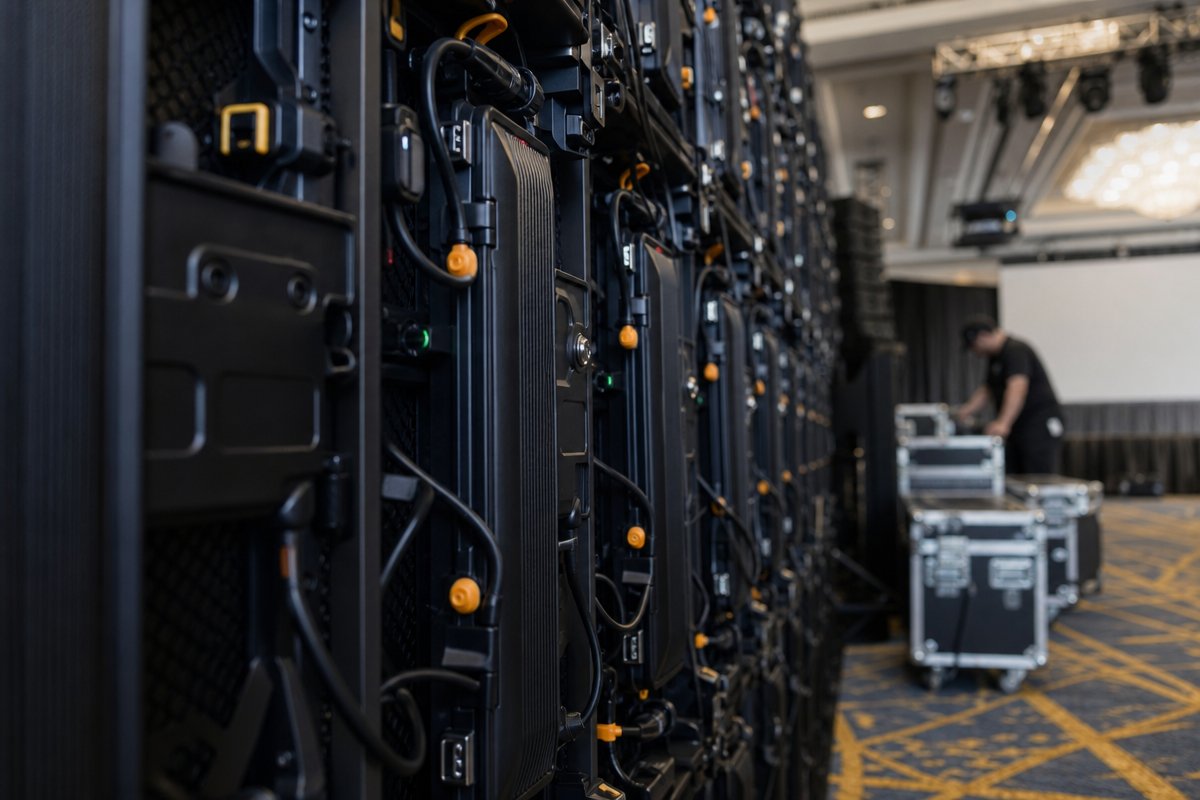
The best audiovisual services in Washington DC don’t start on event day. They start weeks – sometimes months – before a single piece of gear leaves the warehouse. Pre-production is the invisible foundation that determines whether your event runs smoothly or stumbles through technical surprises.
The Site Survey and Venue Assessment
Every DC venue has its own personality – and its own technical quirks. A hotel ballroom in Georgetown has different ceiling heights, power distribution, rigging points, and loading dock access than a conference center on K Street or a historic venue near the National Mall. A professional AV team conducts a thorough site survey that evaluates:
- Power capacity and distribution: How many circuits are available? Where are the panels? Will the lighting rig and LED wall require supplemental power from a generator?
- Rigging points and structural load limits: Can the ceiling support truss-mounted lighting and speakers, or does the team need ground-supported alternatives?
- Loading dock access and freight elevator dimensions: This determines how equipment gets into the room – and how quickly.
- Wi-Fi infrastructure and internet bandwidth: Critical for live streaming, audience engagement apps, and backstage communications.
- Ambient light and acoustic conditions: Windows that flood the room with daylight can wash out projection. Hard surfaces can create echo. Both require solutions planned in advance.
Technical Design and Show Flow Development
Once the venue is assessed, the production team builds out a technical design package. This includes equipment lists, signal flow diagrams, stage plots, and a detailed show flow document that maps every moment of the event to specific AV cues. For a corporate keynote, that might mean coordinating walk-in music, a video sizzle reel, podium microphone activation, confidence monitor content, and lighting transitions – all timed to the speaker’s script.
This planning phase is where experienced AV companies separate themselves from equipment rental vendors. A rental vendor gives you gear. A production partner gives you a plan.
Phase Two: Load-In and the Build – Turning an Empty Room Into a Stage
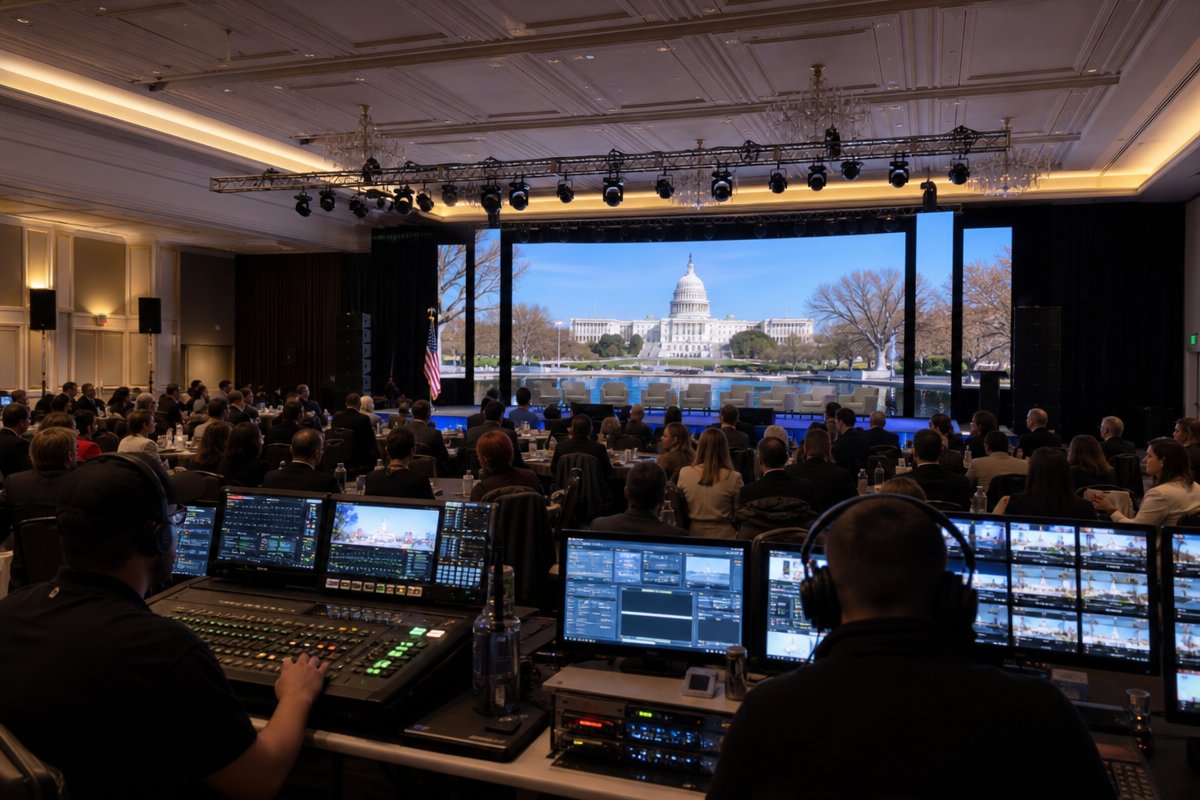
Load-in day is where planning meets execution. For a mid-size corporate event in Washington DC – say, 400 attendees with a main stage, breakout rooms, and a livestream component – the load-in process typically begins 12 to 24 hours before doors open.
What Happens During Load-In
Here’s a realistic timeline of what a professional AV build looks like:
- Truck arrival and dock coordination (Hour 0): Equipment arrives in road cases – speakers, amplifiers, mixing consoles, LED panels, cameras, lighting fixtures, cable, truss, staging elements. The production manager coordinates with venue staff to secure dock time and freight elevator access.
- Staging and scenic installation (Hours 1–3): The physical stage is built first because everything else – lighting, screens, audio – is positioned relative to the stage. Scenic elements like branded backdrops, set pieces, or drape are installed during this phase.
- Rigging and truss assembly (Hours 2–4): If the venue allows overhead rigging, truss is flown to support lighting fixtures, speakers, and projection screens. Ground-supported truss systems are assembled for venues without rigging infrastructure.
- Audio system deployment (Hours 3–5): Main speakers, delay speakers, subwoofers, stage monitors, and the front-of-house mixing position are installed. Wireless microphone frequencies are scanned and coordinated to avoid interference – a critical step in a city like DC where RF congestion is notoriously high due to government and broadcast activity.
- LED wall or projection setup (Hours 3–5): LED panels are assembled tile by tile and calibrated for color accuracy and brightness. Alternatively, projection screens are positioned and projectors are focused and blended if multiple units are creating a single wide image.
- Lighting installation and focus (Hours 4–6): Stage wash, spotlights, accent lighting, and audience lighting are focused and programmed. Gobos, color washes, and moving lights are positioned to match the creative design.
- Video switching and camera setup (Hours 5–7): Cameras are placed, video switching systems are configured, and all content sources – laptops, media servers, playback systems – are connected and tested through the video matrix.

The Controlled Chaos You Don’t See
To an outsider, load-in looks hectic. Cables are everywhere. Cases are stacked. Teams are moving in overlapping patterns. But a seasoned AV crew operates with military precision. Every technician knows the sequence. The audio team doesn’t wait for staging to finish – they’re pre-assembling speaker arrays in the hallway. The video team is programming content on a switcher at a folding table in the back of the room. Efficiency during load-in directly impacts whether rehearsal starts on time, which directly impacts whether the show starts on time.
Phase Three: Rehearsal and Sound Check – Where Problems Get Solved
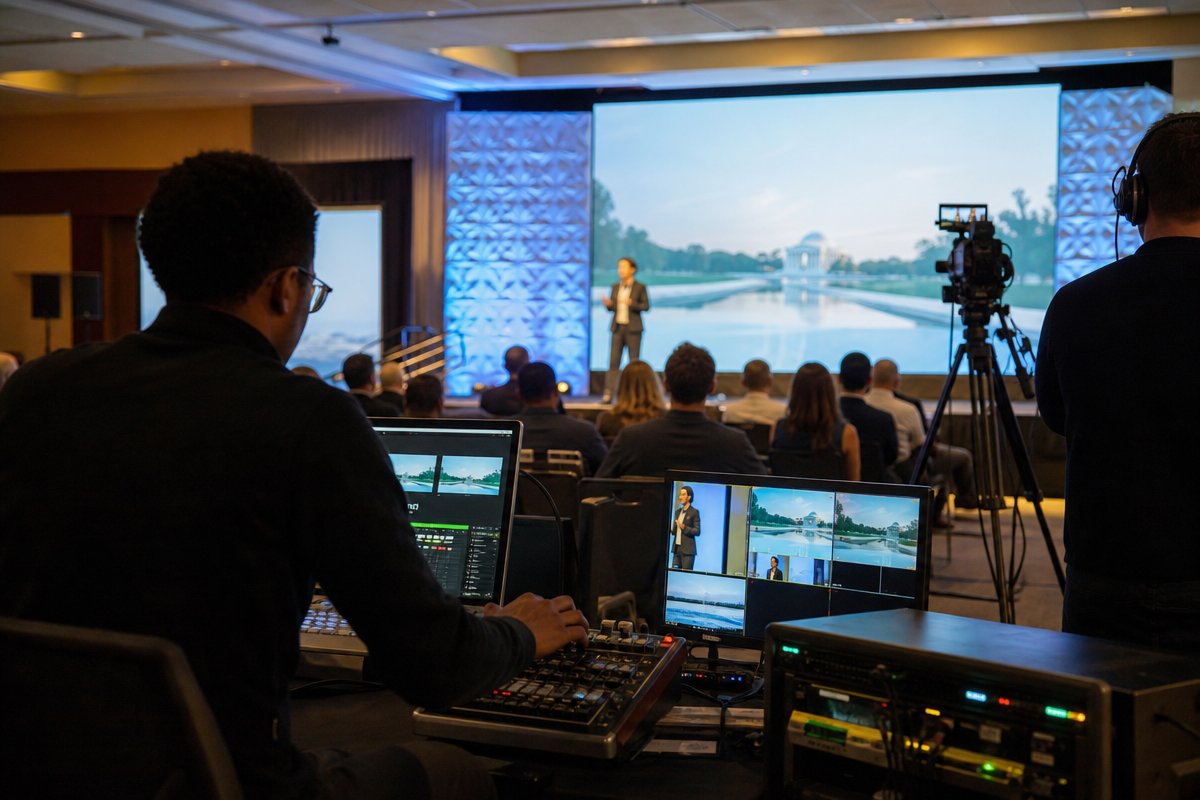
Rehearsal is the most undervalued phase of event production. It’s also the phase that separates polished events from ones that feel improvised.
What Rehearsal Actually Involves
A proper rehearsal isn’t just a speaker walking to the podium and saying, “Can you hear me?” It’s a full technical run that includes:
- Microphone check and gain staging: Every microphone – lavalier, handheld, podium – is tested with the actual speaker whenever possible. Audio levels are set, EQ is adjusted for each voice, and monitor mixes are tailored for presenters who need to hear themselves or playback audio on stage.
- Content playback verification: Every slide deck, video, and animated graphic is loaded, tested, and previewed on the actual screens. Font rendering, video codec compatibility, and aspect ratio issues are caught and fixed here – not during the live presentation.
- Lighting cue walkthrough: The lighting designer programs transitions and confirms that stage lighting doesn’t create glare on LED screens or wash out presenters’ faces on camera.
- Camera blocking: If the event is being recorded or livestreamed, camera operators rehearse their shots. The director confirms switching sequences and ensures confidence monitors display the correct feeds.
- Cue-to-cue run: The stage manager or show caller walks through the show flow, calling each cue to verify that audio, video, and lighting transitions happen in the right sequence at the right time.
This is also when backup plans are tested. What happens if a presenter’s laptop fails? Is there a backup playback system? What if a wireless microphone drops signal? Is there a wired backup on the podium? Professional AV teams in Washington DC plan for failure because the stakes of a live event demand it.
Phase Four: Showtime – Invisible Execution at Its Best
When the doors open and attendees take their seats, the AV team’s goal shifts from building to performing. And the hallmark of great audiovisual execution is invisibility – the audience should never notice the technology. They should only feel its impact.
What’s Happening Behind the Scenes During Your Event
While your keynote speaker commands the stage, here’s what the AV crew is doing simultaneously:
- Front-of-house audio engineer: Continuously mixing live sound, adjusting levels in real time as speakers move closer to or farther from their microphones, managing feedback, and balancing room audio against recordings or broadcast feeds.
- Video director/technical director: Calling camera switches, triggering graphics and lower thirds, managing IMAG (image magnification) feeds for audience screens, and monitoring the livestream output for quality.
- Lighting operator: Executing programmed cues and making live adjustments based on the pace of the show – dimming house lights for a video segment, bringing up stage wash for a panel discussion, triggering color changes for transitions.
- Stage manager: Coordinating talent flow, managing green room timing, cueing speakers, and serving as the communication hub between the production team and the client.
- Playback operator: Advancing slides, triggering video rolls, and standing ready to troubleshoot any content issues in real time.
- Camera operators: Following the action, framing shots, and responding to the director’s calls for wide, medium, and close-up coverage.
In a city like Washington DC, where events frequently include government officials, C-suite executives, and high-profile association leaders, there is zero margin for technical error during the live show. The team backstage is hyper-focused, communicating through intercom headsets, anticipating the next cue before it’s called.

Phase Five: Strike and Load-Out – The Work After the Applause
The event ends. Attendees leave. But the AV team’s day isn’t over. Strike – the process of dismantling and packing out all equipment – begins immediately and often runs late into the night.
What Load-Out Looks Like
Strike follows a reverse sequence of the build:
- Cameras and video switching systems are disconnected and packed first.
- Lighting fixtures are lowered, de-rigged, and cased.
- LED panels are carefully disassembled – each tile is fragile and expensive.
- Audio systems are broken down – speakers, amplifiers, and consoles are cased.
- Staging and scenic elements are disassembled and loaded.
- All cable is coiled, labeled, and packed. The venue is swept clean.
A professional AV company leaves the venue exactly as they found it. That attention to detail reflects the same discipline that defines the entire production process – from the first site survey to the last road case rolling onto the truck.
Why the AV Partner You Choose in DC Matters More Than the Gear
Here’s a truth that experienced event planners in Washington DC already know: the equipment is only as good as the team operating it. Two companies can show up with identical speaker arrays, the same brand of LED panels, and comparable camera packages – and deliver wildly different results.
The difference is in the people. It’s the audio engineer who has mixed 200 events in that exact ballroom and knows where the room resonance builds up at 250 Hz. It’s the lighting designer who understands that the afternoon sun hits the west-facing windows at 3:15 PM and has a plan for it. It’s the project manager who has relationships with every venue’s operations team and knows the loading dock schedule by heart.
When you hire audiovisual services in Washington DC, you’re hiring experience, problem-solving ability, and the calm under pressure that only comes from decades of live event production. That’s not something you can rent from a catalog.
Frequently Asked Questions About Audiovisual Services in Washington DC
How far in advance should I book AV services for a DC event?
For most corporate events, association conferences, and galas in Washington DC, you should engage your AV production partner at least 6 to 12 weeks before your event date. High-profile events or those requiring complex technical designs – large LED walls, multi-camera livestreams, or custom scenic elements – benefit from 3 to 6 months of lead time. Peak season in DC (spring and fall) sees heavy demand, so earlier booking ensures availability of both equipment and experienced crew.
What’s the difference between an AV rental company and a full-service AV production company?
An AV rental company provides equipment – speakers, projectors, screens, microphones – that you or your team operates. A full-service AV production company provides the equipment and the expertise: technical design, creative direction, skilled operators, a show caller, project management, and on-site troubleshooting. For high-stakes events in DC, where flawless execution is non-negotiable, a full-service production partner is the appropriate choice.
How much do professional audiovisual services cost for a corporate event in DC?
Costs vary widely based on scope. A straightforward meeting with a podium microphone, a projector, and a screen might cost a few thousand dollars. A full-scale production with an LED video wall, multi-camera video, professional lighting design, livestreaming, and a full crew can range from $15,000 to $75,000 or more. The key is to communicate your goals and budget early so your AV partner can design a solution that maximizes impact within your financial parameters.
Can AV companies handle events at any venue in Washington DC?
Experienced AV production companies work across every kind of DC venue – hotel ballrooms, convention centers, historic landmarks, outdoor spaces, rooftops, and non-traditional venues like museums and galleries. The critical factor is the site survey: a professional team assesses power, rigging, access, and acoustics at any venue to ensure the technical plan is tailored to that specific space. Companies with 20 or 30 years of experience in the DC market have likely worked at most major venues multiple times.
What should I provide to my AV team before the event?
To ensure smooth production, provide your AV partner with: the final agenda and show flow, all presentation files and video content at least 48 to 72 hours before the event, speaker names and microphone preferences, branding guidelines and logos for screen graphics, and any special requirements such as accessibility needs, foreign language interpretation, or press pool accommodations. The more information your AV team has in advance, the fewer surprises arise on event day.
Do I need a separate company for lighting, audio, and video?
No – and in fact, using separate vendors for each discipline often creates coordination challenges and finger-pointing when issues arise. A single full-service AV production company integrates audio, video, lighting, staging, and show management under one project manager. This unified approach means all technical elements are engineered to work together – and there is one point of accountability for the entire production.
Your Event Deserves More Than Plugged-In Equipment
Every event in Washington DC tells a story – about your organization, your mission, your brand. The audiovisual production behind that event is what transforms a room full of chairs into an immersive experience that moves people, informs decisions, and builds lasting impressions.
At TriVision Event Production, we’ve been delivering professional audiovisual services in Washington DC, Northern Virginia, and Maryland for over 30 years. From the first site survey to the last cable coiled at load-out, our team brings the technical expertise, creative vision, and operational discipline that high-stakes events demand. We don’t just set up AV equipment – we engineer experiences.
If you’re planning a corporate event, association conference, gala, or summit in the DC area in 2026, contact TriVision Event Production to start the conversation. Let’s build something your audience will remember.
Let’s talk about your event
Tell us the date and the room - we’ll bring the plan.