
Quick answer: Screen size matters once your audience, room depth, or ambient light outgrows standard displays. The rule of thumb: the farthest comfortable viewer sits about 6 to 8 times the screen height away, so deeper rooms demand taller screens. Audience size, venue conditions, sightline angles, and rigging capacity determine when a large LED screen becomes necessary rather than a luxury.
Your keynote speaker is on stage, the content is brilliant, and half the audience is squinting. That is the painful reality of undersized screens at large-scale events – and it is far more common than most planners realize. If you are producing an event for 500, 1,000, or 5,000+ attendees in the nation’s capital, large LED screen rental in Washington DC is not a luxury line item. It is the single most important decision that determines whether your audience actually sees your event. In our experience, visual clarity does more to shape attendees’ perception of event quality than almost any other factor – often more than audio, catering, or even the content itself.
This is not a rehash of general LED wall pricing or a rundown of indoor versus outdoor options. This is a technical, service-focused guide built for planners and producers who need to understand when and why to go big with LED screens, how to calculate the right size for DC’s most demanding venues, and what rigging, resolution, and logistics considerations separate a flawless show from an expensive mistake.
When Does Your DC Event Actually Need a Large LED Screen?
Not every event requires a massive display. But the threshold for needing one arrives sooner than most planners expect. Here is a practical framework based on decades of production experience across the DMV region.
Audience Size Thresholds
- Under 150 attendees: Projection or a single mid-size LED panel (around 8 feet wide) often suffices in an intimate ballroom setting.
- 150–500 attendees: This is the gray zone. Depending on room depth and seating configuration, you may need a screen 12 to 16 feet wide for reliable sightlines to the back rows.
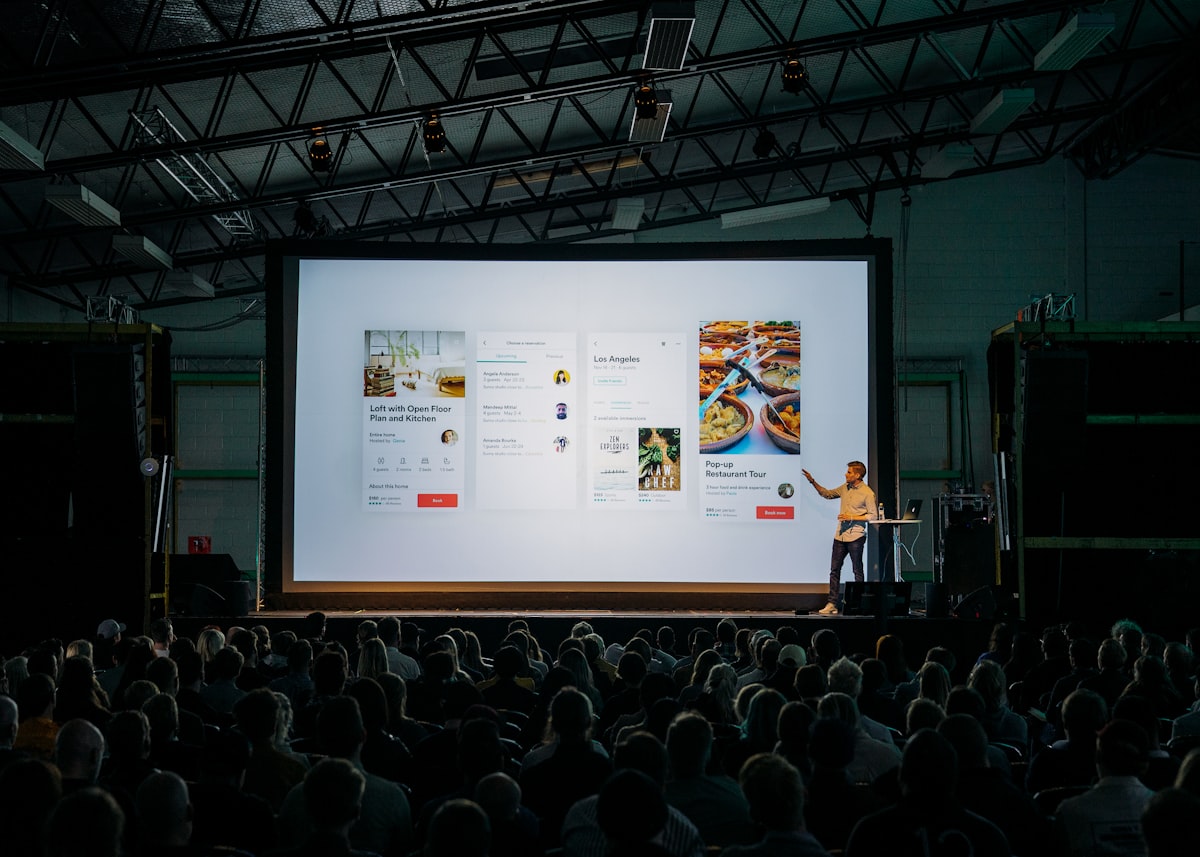
- 500–2,000 attendees: A large LED wall – typically 16 to 24 feet wide – becomes essential. At this scale, projection often cannot compete with ambient light, and content legibility degrades rapidly for rear-seated attendees.
- 2,000+ attendees: You are in arena-scale territory. Expect 24- to 40-foot-wide primary screens, often supplemented with IMAG (Image Magnification) side screens, delay screens, or overhead ribbon boards.
Venue Conditions That Force the Upgrade
Audience size alone does not tell the whole story. Several venue-specific factors in Washington DC push events toward larger LED screens even when headcounts are moderate:
- High ambient light: Venues with floor-to-ceiling windows – like many rooftop spaces and museum atriums along the National Mall – wash out projection. LED panels deliver 1,500 to 6,000+ nits of brightness, making them the only viable option in daylight-adjacent environments.
- Wide, shallow rooms: Some of DC’s most popular convention and hotel ballrooms (think the Walter E. Washington Convention Center or the Marriott Marquis) have wide footprints where a single narrow screen leaves extreme-angle seats with no usable view.
- Outdoor and hybrid venues: Any event with an outdoor component – from the steps of the Kennedy Center to a National Harbor waterfront activation – requires direct-view LED that can handle sun exposure and weather variables.
- Multi-camera IMAG presentations: When you are magnifying a speaker’s face across a ballroom, pixelation is unforgivable. Large, fine-pitch LED walls deliver the clarity that projection cannot match at scale.
Sightline Calculations: The Math Behind the Right Screen Size
Going big for the sake of spectacle is one thing. Going big because the math demands it is where professional event production separates from guesswork. Here is how experienced producers calculate optimal LED screen dimensions for large DC events.
The 6x/8x Rule for Viewing Distance
The industry standard rule of thumb states that the maximum comfortable viewing distance for a screen is approximately 6 to 8 times the screen height for content-heavy presentations (text, data, slides). For video and cinematic content, you can stretch to 8 to 10 times screen height.
Here is what that means in practice:
- A screen that is 8 feet tall provides comfortable text legibility up to about 48–64 feet from the screen.
- A screen that is 12 feet tall extends comfortable viewing to 72–96 feet.
- A screen that is 16 feet tall covers 96–128 feet – enough for a deep ballroom at the Convention Center.
If your last row of seating is 150 feet from the stage, you need a screen at least 18 to 20 feet tall to keep slide content legible. This is not opinion – it is optical math, and ignoring it is one of the most common mistakes in DC event production.
Width-to-Height Ratios
Most corporate events use a 16:9 aspect ratio to match standard HD and 4K content. That means a 12-foot-tall screen will be approximately 21 feet wide. Some events opt for ultra-wide configurations (32:9 or custom panoramic ratios) for immersive stage designs, which requires even more LED real estate but creates a dramatically different visual impact.

Do Not Forget Sightline Angles
Screen size is only half the equation. Screen placement height matters enormously. If the bottom of your LED wall is only 4 feet off the floor and your audience is seated on a flat floor (no risers), attendees beyond the tenth row will have their view blocked by heads in front of them. In flat-floor ballroom configurations, the bottom of the screen should be at least 6 to 8 feet off the floor – which changes rigging and structural requirements significantly.
Rigging Requirements for Large LED Screens in DC Venues
This is where planning meets physics. A 16-by-9-foot LED wall can weigh anywhere from 1,500 to 4,000+ pounds depending on panel type and configuration. Getting that safely into position – and keeping it there for the duration of your event – requires serious technical planning.
Venue Rigging Point Assessment
Before a single LED panel arrives on site, your production team needs to conduct a rigging survey of the venue. Key questions include:
- Does the venue have structural rigging points rated for the load? Many DC hotel ballrooms have ceiling rigging grids, but weight ratings vary wildly – some max out at 600 pounds per point, while convention halls may support several thousand.
- What is the trim height (distance from floor to the rigging grid)? Low ceilings may prevent overhead flying of large screens.
- Are there existing house fixtures (chandeliers, lighting tracks, HVAC ducts) that block optimal screen placement?
- Does the venue require a third-party structural engineering certification for any rigged load over a certain weight? Many DC convention venues and historic properties mandate this.
Ground-Stacked vs. Flown Configurations
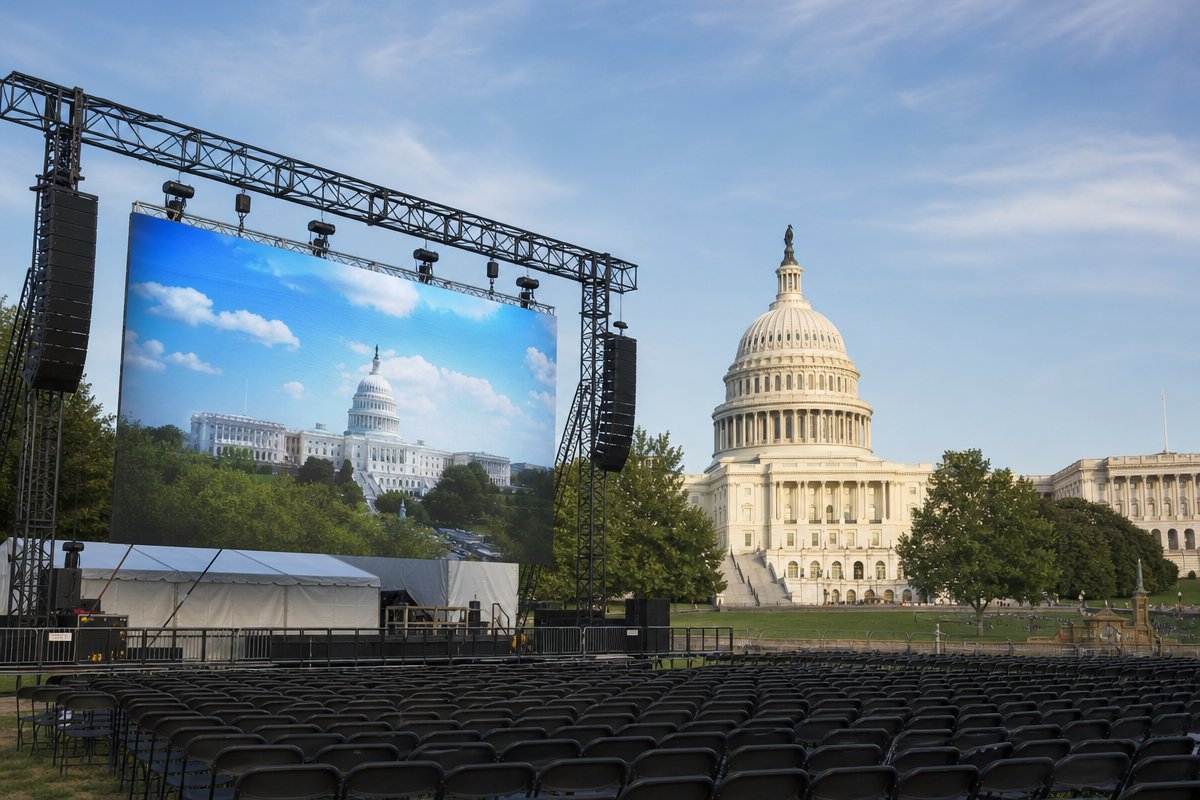
When rigging from above is not feasible – or when the screen is so large that flying becomes impractical – ground-stacking on a reinforced base structure is the alternative. Ground-stacked LED walls are common for screens under 16 feet tall and are standard for outdoor festival stages. However, ground-stacking raises the sightline challenge discussed above: you may need a raised stage or tiered seating to compensate.
For truly massive displays – think 20 feet tall and wider – a hybrid approach is often used: the lower section is ground-supported while the upper section is flown from overhead rigging, distributing the load across multiple structural points.
Load-In Logistics Specific to DC
Washington DC presents unique logistical challenges for large LED screen deployments:
- Loading dock access: Many downtown DC hotels and venues have tight loading docks with low clearance, narrow corridors, and freight elevators that limit the size of individual LED panel crates that can enter the building.
- Street permits and truck staging: For Convention Center events or activations near federal property, you may need DC Department of Transportation permits for truck staging, load-in windows, and lane closures.
- Union labor requirements: Several major DC venues are union houses, meaning your production team must coordinate with IATSE or other local labor unions for rigging and electrical work.
- Setup time: A large LED wall (20+ feet) typically requires 6 to 12 hours for assembly, rigging, alignment, and calibration. Your venue contract needs to account for this – a common oversight that creates expensive overtime charges.
Resolution and Pixel Pitch: Why Going Big Means Going Fine
Here is the technical trap that catches uninformed buyers: you can rent the largest LED wall available and still end up with a display that looks terrible if the pixel pitch is wrong for the viewing distance and content type.
What Is Pixel Pitch and Why Does It Matter?
Pixel pitch is the distance (in millimeters) between the center of one LED pixel and the center of the adjacent pixel. Smaller pixel pitch = higher resolution = sharper image. Common pixel pitches for event LED walls include:
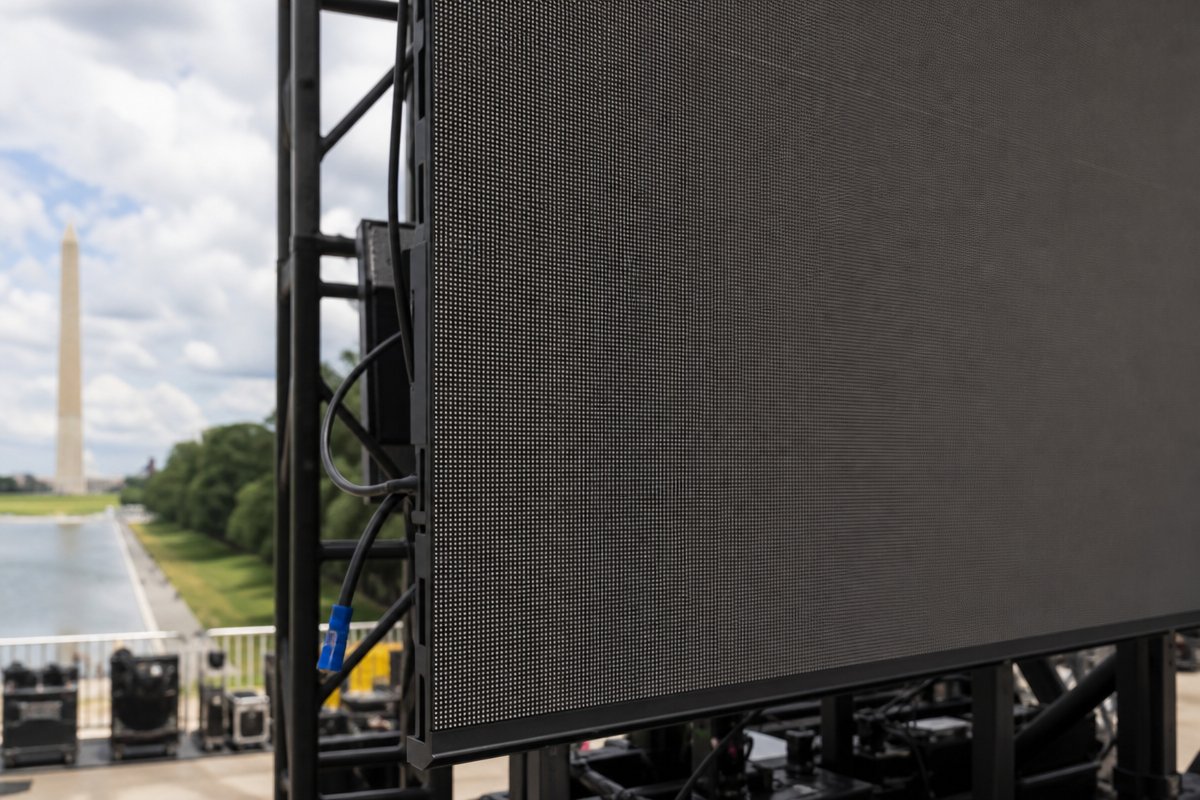
- 1.5mm – 2.5mm: Fine pitch. Ideal for close viewing distances (under 15 feet), broadcast-quality IMAG, and events where cameras will capture the screen.
- 2.9mm – 3.9mm: The sweet spot for most indoor corporate events with viewing distances of 15 to 60 feet.
- 4.8mm – 5.9mm: Suitable for large venues with viewing distances exceeding 50 feet, or outdoor events where extreme resolution is less critical.
- 6mm+: Outdoor festival and stadium-grade panels for long-distance viewing.
Matching Pixel Pitch to Screen Size and Viewing Distance
The general rule: minimum viewing distance (in feet) ≈ pixel pitch (in mm) × 3.28. So a 2.9mm panel looks sharp from about 9.5 feet away and beyond. A 5.9mm panel needs at least 19 feet of distance before individual pixels become invisible to the naked eye.
For a large LED screen rental in Washington DC – say a 20-foot-wide wall for a 1,200-person conference – you would typically spec 2.9mm to 3.9mm panels. Going coarser saves money but risks visible pixelation for front-row VIPs and any camera capture. Going finer than necessary inflates costs without a visible quality improvement for most of the audience.
Content Resolution: Feed the Beast
A large, fine-pitch LED wall is only as good as the content driving it. If your presentation slides were designed at 1920×1080 and your screen has a native resolution of 3840×2160, the content will be upscaled and soft. Work with your production team to ensure:
- All video content is rendered at the native resolution of the LED wall or higher.
- Presentation slides are designed at the correct aspect ratio and resolution – not default PowerPoint dimensions.
- Graphics and logos are vector-based or high-DPI raster files to avoid pixelation on large displays.
- Your video playback system (media server) can output at the wall’s native resolution without frame dropping or scaling artifacts.
Real-World Applications: Where Large LED Screens Shine in DC
Across more than 30 years of event production in Washington DC, Northern Virginia, and Maryland, certain event types consistently demand large-format LED solutions. Here are the most common use cases:
National Association Conferences
DC is the association capital of the world, and annual conferences at venues like the Walter E. Washington Convention Center routinely require 20- to 30-foot-wide main stage screens with IMAG side screens. Attendee counts of 2,000 to 10,000+ make large LED walls non-negotiable.
Corporate Town Halls and Product Launches
When a Fortune 500 company gathers its leadership in DC for a major announcement, the visual impact of a single unbroken, ultra-bright LED image sets the tone. These events often feature cinematic video content, live data dashboards, and multi-camera speaker magnification – all of which demand large, high-resolution displays.
Galas, Award Shows, and Fundraisers
High-profile nonprofit galas and political fundraisers in DC rely on large LED screens for donor recognition, live auction displays, and entertainment visuals. The scenic design possibilities – curved screens, L-shaped configurations, floor-to-ceiling immersive walls – turn the LED investment into both a functional and aesthetic centerpiece.
Outdoor Festivals and Public Events
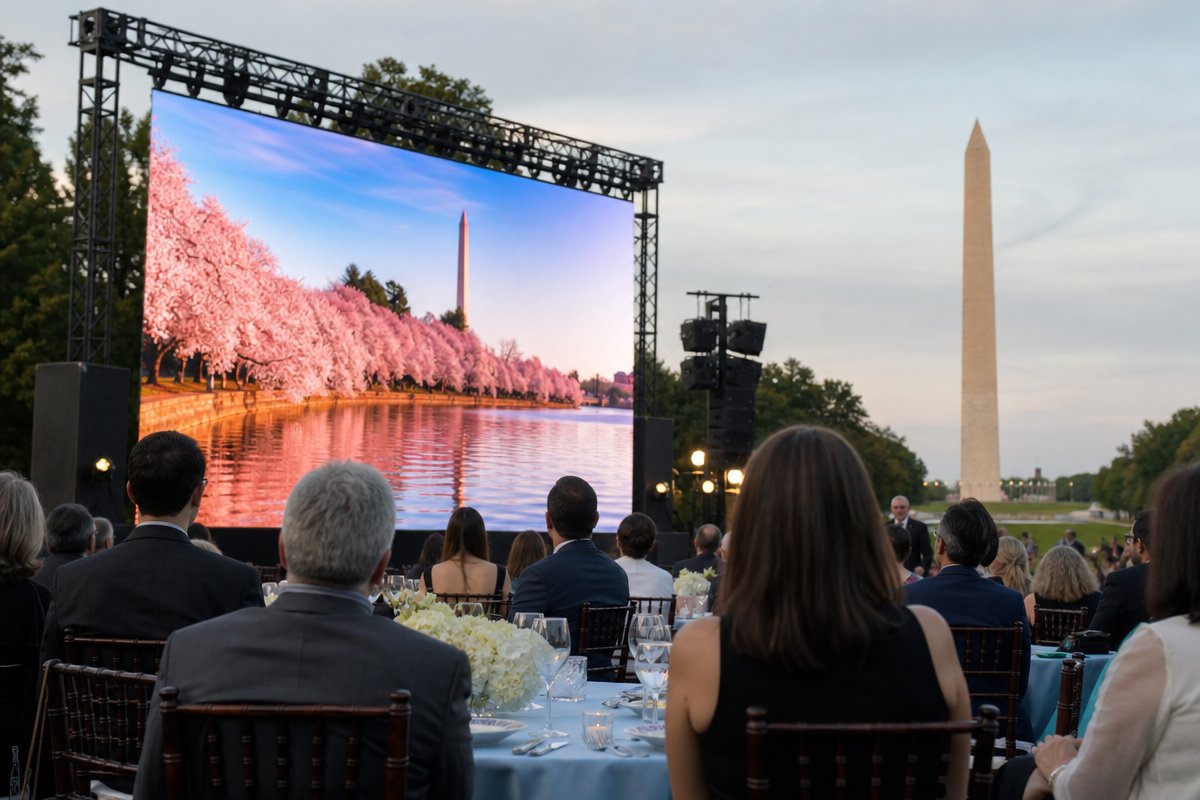
From the National Mall to The Wharf, outdoor events in DC face direct sunlight, variable weather, and massive crowd spreads. Large outdoor-rated LED panels (typically 5.9mm or 6mm+ pitch with high nit output) are the only display technology that performs reliably in these conditions.
Frequently Asked Questions About Large LED Screen Rental in Washington DC
What size LED screen do I need for 1,000 attendees?
For a 1,000-person event in a standard DC ballroom, plan for a primary LED screen that is at least 16 to 20 feet wide and 9 to 12 feet tall in a 16:9 format. If the room is wider than 80 feet, consider adding flanking IMAG screens (10 to 12 feet wide each) to ensure sightlines for attendees seated at extreme angles. The exact size depends on room depth – apply the 6x to 8x screen height rule to confirm your last-row viewing distance is covered.
How far in advance should I book a large LED screen rental in DC?
For peak season events (March through June and September through November) in Washington DC, book your LED wall at least 8 to 12 weeks in advance. Large-format LED inventory – particularly fine-pitch panels in the 2.5mm to 3.9mm range – is limited, and major association conferences and government events can reserve available stock months ahead. For events at the Convention Center or major hotel ballrooms, 3 to 4 months of lead time is advisable.
Can any venue in DC support a large LED wall?
Not automatically. Venue suitability depends on structural rigging capacity, ceiling height, loading dock access, power availability (large LED walls can draw 20 to 60+ amps depending on size), and floor load ratings. A professional production company will conduct a site survey before committing to a specific screen configuration. Some historic DC venues have strict weight and rigging limitations that require creative ground-stacked solutions.
What is the difference between LED walls and projection for large events?
LED walls produce their own light (direct-view emissive technology), making them dramatically brighter than projection – typically 1,500 to 6,000+ nits versus 5,000 to 30,000 lumens for projectors (which degrades significantly with throw distance and ambient light). For events over 500 attendees, in rooms with ambient light, or for any outdoor application, LED walls deliver vastly superior image quality, contrast, and color accuracy. Projection remains viable for smaller, light-controlled environments or as a budget-conscious supplement.
Do I need to provide content at a specific resolution for a large LED screen?
Yes. Every LED wall has a native pixel resolution determined by its physical dimensions and pixel pitch. Your production team will provide the exact resolution spec – for example, a 20-foot-wide wall built from 2.9mm panels might have a native resolution of approximately 3456×1944 pixels. All video, graphics, and presentation content should be designed or exported to match this resolution for optimal sharpness. Upscaling lower-resolution content will result in a soft, blurry image.
What does a large LED screen rental cost for a DC event in 2026?
Pricing varies significantly based on screen size, pixel pitch, indoor vs. outdoor rating, rental duration, rigging complexity, and labor. As a rough benchmark for 2026, a large indoor LED wall (approximately 16 by 9 feet, 2.9mm pitch) for a two-day corporate event in Washington DC – including delivery, setup, operation, and teardown – typically ranges from $15,000 to $35,000+. Ultra-large configurations (24+ feet wide) with fine-pitch panels and complex rigging can exceed $50,000. The best approach is to request a detailed, itemized quote from a full-service production company that includes all labor, logistics, and technical support.
Make Your Next DC Event Impossible to Ignore
With large LED screen rental in Washington DC, size is not about showing off – it is about ensuring every attendee in the room has an equal, high-quality visual experience. The difference between a good event and a great one often comes down to whether the back row felt as connected as the front row.
Getting the screen size, pixel pitch, rigging, and content resolution right requires more than a product catalog. It requires a production partner with deep venue knowledge, structural expertise, and the technical inventory to execute at scale.
TriVision Event Production has been delivering end-to-end event production – including large-format LED wall solutions – for corporate and organizational clients across Washington DC, Northern Virginia, and Maryland for over 30 years. From sightline calculations and rigging surveys to content optimization and show-day operation, our team handles every detail so your audience sees exactly what you intended.
Ready to plan your next large-scale event? Contact TriVision Event Production for a consultation and custom LED screen recommendation tailored to your venue, audience, and vision.
Let’s talk about your event
Tell us the date and the room - we’ll bring the plan.