
Quick answer: Vet any event production company across five categories before signing: experience and track record, equipment and technology, staffing and crew, insurance/contracts/compliance, and contingency planning and communication. The single most revealing question is what happens if a critical piece of equipment fails mid-event – the right answer involves on-site backups, redundant signal paths, and a dedicated monitoring technician. Get detailed proposals from three to five firms, starting four to six months before your event date.
You have a high-stakes corporate event on the horizon – a leadership summit, a gala, a product launch – and the production partner you choose will either carry the experience or leave you scrambling behind the scenes. Talk to planners after a difficult event, and the same regret comes up again and again: they did not vet their production vendor thoroughly enough before signing a contract. The right questions to ask an event production company can mean the difference between a flawless show and a costly disaster. This checklist, organized by category, gives you the exact framework to evaluate any event production partner in Washington DC, Northern Virginia, or Maryland in 2026.
Whether you are coordinating a 200-person fundraiser at the National Building Museum or a multi-day conference at the Gaylord National Resort, these 25 questions will help you cut through polished sales pitches and uncover the partners who genuinely have the expertise, equipment, and contingency planning your event demands.
Category 1: Experience and Track Record

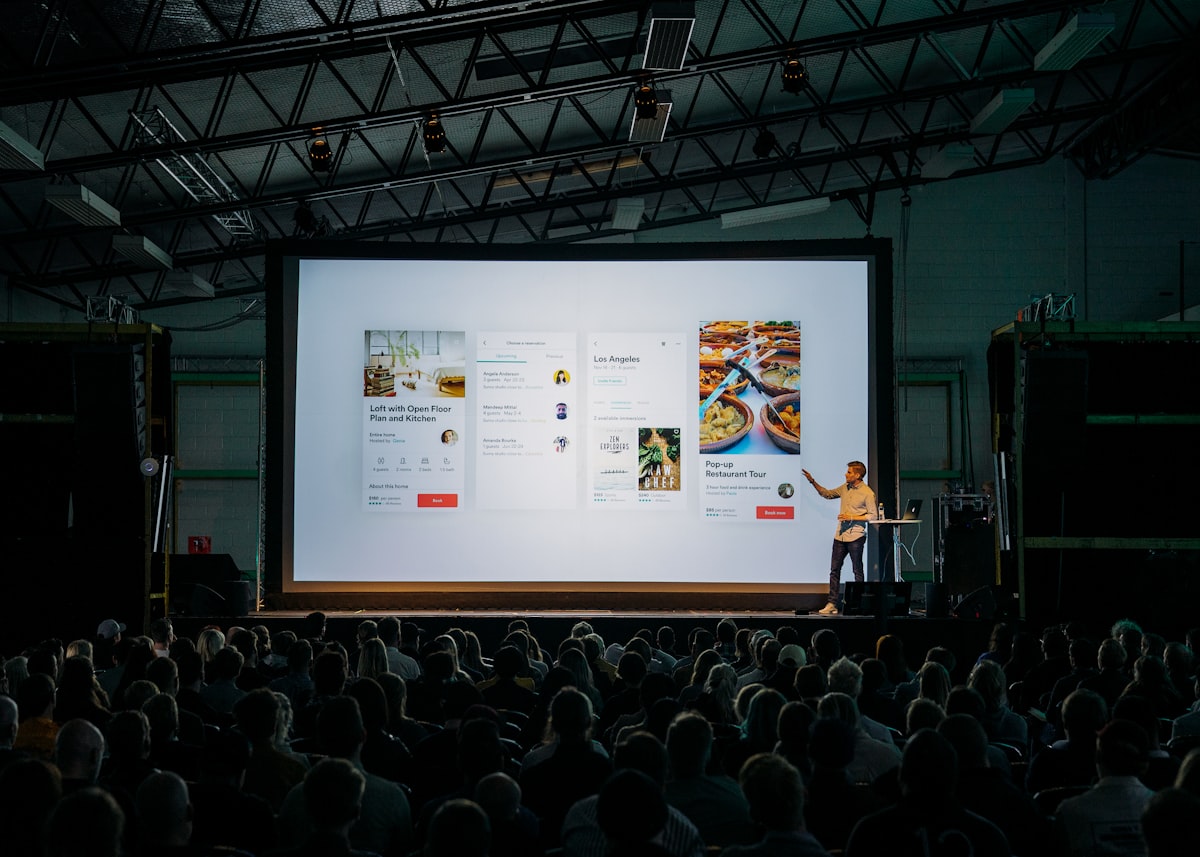
Before you discuss equipment specs or pricing, you need to understand who you are actually hiring. Experience in event production is not generic – it is venue-specific, event-type-specific, and region-specific. A company that excels at outdoor festivals may flounder in a federal ballroom with strict security protocols. Start here.
Question 1: How many years have you been producing events in this region?
Longevity matters. A company that has operated in the DMV area for decades understands the unique logistics of DC venues – loading dock restrictions, union requirements at convention centers, and the permit process. Look for partners with at least 10 years of regional experience.
Question 2: Can you share three references from events similar to mine?
Do not accept a generic client list. Ask for references from events that match your type (corporate, nonprofit, government), your scale (attendee count), and your venue category. Then actually call those references and ask about communication, problem-solving, and on-site professionalism.
Question 3: Have you worked at my specific venue before?
Venue familiarity eliminates a massive category of risk. A production company that knows the power capacity, rigging points, Wi-Fi infrastructure, and load-in routes at your venue will save hours of advance work and avoid day-of surprises.
Question 4: What is the largest and most complex event you have produced?
This question reveals ceiling capacity. If your event involves multiple breakout rooms, simultaneous live streaming, and LED video walls, you need a partner whose operational ceiling is well above your requirements – not one that will be stretching to meet them for the first time.
Question 5: Do you specialize in any particular event types?
Some production companies focus on concerts, others on corporate events, and others on broadcast. Specialization in corporate and organizational events – galas, conferences, government meetings – means the team understands the pacing, formality, and stakeholder expectations unique to those formats.
Category 2: Equipment and Technology
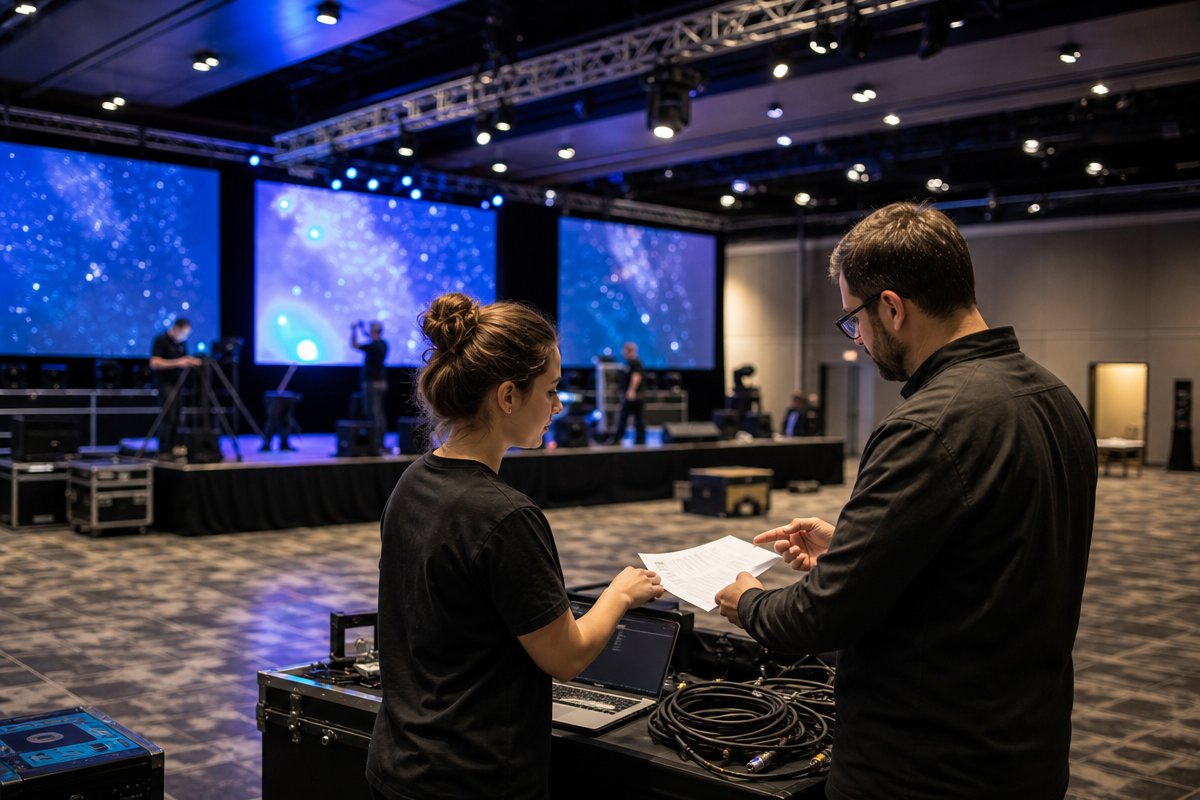
The audiovisual equipment and technology a production company brings to your event directly impacts the attendee experience. Outdated projectors, underpowered sound systems, and low-resolution LED panels will undermine even the most carefully planned agenda. These questions help you assess technical capability.
Question 6: Do you own your equipment or sub-rent it?
Companies that own their inventory have more control over quality, availability, and pricing. Sub-renting introduces a middleman, potential equipment substitutions, and less accountability if something malfunctions. Ask what percentage of the gear for your event will come from their own warehouse.
Question 7: What LED wall pixel pitch and panel brands do you carry?
For events requiring LED video walls, pixel pitch determines image clarity at various viewing distances. A company should be able to recommend the right pixel pitch for your room size and content type – and explain why. Look for reputable panel brands like ROE Visual, Absen, or similar professional-grade manufacturers.
Question 8: How current is your equipment inventory?
Technology evolves rapidly. Ask when their core equipment – mixing consoles, wireless microphone systems, laser projectors, LED panels – was last updated. A company still relying on 2018-era gear may deliver a noticeably inferior experience compared to one investing in current technology.
Question 9: What happens if a critical piece of equipment fails during my event?
This is a non-negotiable question. The answer you want to hear involves on-site backup equipment, redundant signal paths for audio and video, and a technician dedicated to monitoring systems throughout the show. If their answer is vague, that is a red flag.
Question 10: Can you integrate with my venue’s in-house systems?
Many DC-area hotels and convention centers have built-in audio systems, projection infrastructure, or house lighting. A skilled production partner should be able to assess whether to supplement, replace, or integrate with those systems – and explain the trade-offs of each approach.
Category 3: Staffing and Crew

Equipment is only as good as the people operating it. The technical crew on-site during your event will handle real-time audio mixing, lighting cues, video switching, and stage management. Their skill level, professionalism, and communication directly affect your event’s success.
Question 11: Who will be my primary point of contact before, during, and after the event?
You need a dedicated project manager or producer – not a sales rep who disappears after the contract is signed. Clarify whether this person will be on-site during the event and how they will communicate with your team in real time.
Question 12: How many crew members will be on-site, and what are their roles?
Ask for a staffing plan that lists each crew member’s role: audio engineer, lighting designer, video technician, stage manager, LED technician, and so on. Understaffing is one of the most common ways production companies cut costs – and it always shows during the event.
Question 13: Are your crew members full-time employees or freelancers?
Both models can work, but full-time crew members tend to have more consistent training, deeper familiarity with the company’s equipment, and stronger communication protocols. If freelancers are used, ask how the company vets and trains them.
Question 14: What experience does your technical director or show caller have?
The technical director (TD) or show caller is the person who orchestrates every cue during your event. Their experience level is arguably the most important staffing factor. Ask how many similar events they have called and whether you can meet or speak with them before signing.
Question 15: Will crew be present for the entire load-in, event, and load-out?
Some companies reduce crew during certain phases to save money. Make sure the full technical team is present during rehearsals, the live event, and the initial load-out. Early crew departures can create problems if last-minute adjustments are needed.
Category 4: Insurance, Contracts, and Compliance
This is the category most planners skip – until something goes wrong. Insurance gaps, vague contract language, and compliance oversights can expose your organization to significant liability. In the DC area, where government and nonprofit events often have strict requirements, these questions are especially critical.

Question 16: What insurance coverage do you carry?
At minimum, your production partner should carry general liability insurance (typically $1 million per occurrence / $2 million aggregate), workers’ compensation, and equipment insurance. Ask for a certificate of insurance (COI) and verify that your organization can be added as an additional insured.
Question 17: What is your cancellation and rescheduling policy?
Events get postponed. Budgets shift. Weather intervenes. Understand the financial implications of changes at 90 days, 60 days, 30 days, and under two weeks before the event. Look for partners who offer reasonable flexibility rather than punitive cancellation fees.
Question 18: What exactly is included in the quoted price, and what triggers additional charges?
The most common source of vendor disputes is unexpected charges. Ask specifically about overtime rates, additional setup time, power distribution fees, rigging labor, and travel costs. A transparent production company will provide an itemized proposal, not a lump-sum mystery.
Question 19: Are you compliant with venue, union, and jurisdictional requirements?
In Washington DC and Maryland, certain venues require union labor for rigging or electrical work. Government events may require specific security clearances or GSA compliance. Your production partner should know these requirements before you have to ask.
Question 20: How do you handle intellectual property and content ownership?
If the production company creates video content, motion graphics, or scenic designs for your event, who owns that content after the event? Clarify this in writing before signing. Most organizations expect to retain full ownership of custom content they have paid to produce.
Category 5: Contingency Planning and Communication
The hallmark of a truly professional event production company is not what they do when everything goes right – it is what they do when something goes wrong. Weather disruptions, power outages, speaker no-shows, and last-minute agenda changes are inevitable across a long enough timeline. These final questions test operational maturity.
Question 21: What is your contingency plan for power failure?
Ask whether they bring uninterruptible power supplies (UPS) for critical systems, whether they can source backup generators, and how quickly they can restore operations after a power interruption. For high-visibility events, even a 30-second blackout can be unacceptable.
Question 22: How do you handle last-minute changes to the run of show?
Events rarely unfold exactly as scripted. A strong production partner should describe a clear communication protocol – how changes are communicated from your team to the TD, how quickly the crew can adapt, and what tools (comms headsets, cue sheets, show management software) they use to stay synchronized.
Question 23: Do you conduct a site visit and technical advance before the event?
A site visit is non-negotiable for any event with meaningful production value. During the technical advance, the production team should assess power access, rigging capacity, acoustic challenges, lighting conditions, and load-in logistics. If a company skips this step, they are not serious.
Question 24: What is your communication plan on event day?
Ask about the comms infrastructure: Do they use a dedicated radio channel? Is there a clear chain of command? How will the production team communicate with your event coordinator, the venue staff, and any other vendors? Clear lines of communication are the backbone of smooth execution.
Question 25: Can you walk me through a past event where something went wrong and how you handled it?
This is perhaps the most revealing question on the entire list. The answer will tell you whether the company has genuine operational resilience or whether they are hoping nothing goes wrong. Listen for specifics: what failed, what they did in the moment, what they changed afterward. Vague or defensive answers are disqualifying.
Frequently Asked Questions
How many event production companies should I get quotes from?
We recommend requesting detailed proposals from three to five companies. This gives you enough variation to compare pricing, staffing approaches, and equipment quality without overwhelming your evaluation process. Focus on companies that specialize in your event type and have experience in your region, such as the Washington DC, Northern Virginia, and Maryland area.
What is the most important question to ask an event production company?
While every question on this list serves a purpose, Question 9 – about equipment failure contingency – is often the most revealing. It forces the company to demonstrate operational maturity, backup planning, and crew preparedness. Companies that stumble on this question may not be ready for high-stakes events.
Should I always choose the lowest-priced event production company?
No. In event production, the lowest bid often reflects understaffing, older equipment, or hidden fees that appear after the contract is signed. Instead of comparing on price alone, evaluate the total value: equipment quality, crew experience, insurance coverage, contingency planning, and post-event support. A slightly higher investment often prevents far more expensive problems.
When should I start talking to event production companies?
For large-scale corporate events, conferences, and galas in the DC area, begin your vendor search four to six months before the event date. This allows time for site visits, technical planning, custom scenic design, and equipment reservations – especially during peak event seasons in spring and fall.
What red flags should I watch for when vetting production companies?
Watch for these warning signs:
- Reluctance to provide references or a certificate of insurance
- No site visit or technical advance process
- Vague or lump-sum proposals without line-item detail
- Inability to name the specific crew members who will work your event
- No backup equipment or contingency plan
- High-pressure sales tactics or unusually low pricing
Do I still need to ask these questions if the venue recommends a preferred production company?
Absolutely. Preferred vendor relationships are often based on convenience or revenue-sharing agreements, not necessarily on quality or fit for your specific event. Use this same checklist to evaluate any recommended vendor just as rigorously as you would an outside company.
Sign Your Contract with Confidence
Asking the right questions to ask an event production company is not about being difficult – it is about protecting your event, your budget, and your reputation. Every question on this list is designed to surface the information that separates a reliable production partner from one that will leave you exposed on event day.
At TriVision Event Production, we have spent over 30 years answering these questions for corporate and organizational clients across Washington DC, Northern Virginia, and Maryland. We welcome every item on this checklist because transparency is how we build long-term partnerships. From audio and lighting to LED video walls, staging, show management, and creative strategy, we deliver full-service event production built on experience, accountability, and technical excellence.
Ready to vet a production partner who welcomes tough questions? Visit trivisioneventproduction.com to schedule a consultation and discover why leading organizations in the DMV trust TriVision with their most important events in 2026 and beyond.
Let’s talk about your event
Tell us the date and the room - we’ll bring the plan.