
Quick answer: End-to-end means one accountable partner covering strategy and creative, audio, visual technology, lighting, staging and scenic, video and streaming, and show management – from pre-production planning through on-site execution and strike. If a vendor cannot own all seven, they are not full-service.
You have been told by three different vendors that they offer full service event production. One is really an AV rental house. Another is a freelance show caller with a website. The third quotes you a lighting package but cannot explain who is running sound. In our experience, planners who coordinate three or more separate production vendors frequently end up with at least one significant technical failure during their event. The phrase ‘full-service’ gets thrown around so loosely in the events industry that it has nearly lost all meaning – and that ambiguity costs planners time, money, and sometimes their reputations.
This article breaks down what end-to-end event production actually looks like when the term is used honestly. If you are planning a corporate conference, association gala, government briefing, or large-scale organizational event in Washington DC, Northern Virginia, or Maryland in 2026, understanding this distinction is not optional – it is the difference between a show that runs itself and a logistical nightmare.
The ‘Full-Service’ Myth: Why Most Vendors Cannot Deliver What They Promise
Let us start with the uncomfortable truth. The majority of companies that market themselves as full-service event production providers are actually specialists in one or two disciplines who have learned that the label attracts bigger contracts. There is nothing inherently wrong with specialization, but there is a serious problem when a client believes they are getting comprehensive production management and instead receives a patchwork of subcontracted services with no single point of accountability.
What Piecemeal Coordination Actually Looks Like
Here is a scenario that plays out hundreds of times a year across the DMV region:
- You hire an AV company to handle sound and projection.
- You separately contract a lighting designer who brings their own crew.
- You rent an LED video wall from a third vendor who drops it off and leaves.
- You ask your venue’s in-house team to handle staging.
- You assign your internal marketing coordinator to manage show flow.
On paper, every technical need is covered. In practice, nobody owns the production. The lighting designer does not know what the AV company’s projection mapping requires. The LED wall vendor has no idea what content format your graphics team delivered. The venue’s staging crew built the platform before anyone confirmed sight lines. And your marketing coordinator – talented as they are – has never called a live show.
This is not full-service event production. This is vendor aggregation, and it is the single most common source of preventable event failures.
The Accountability Gap
When five vendors share responsibility, nobody is responsible. If the audio feeds back during the keynote, the sound engineer blames the room acoustics. The venue blames the AV company. The AV company blames the staging layout. The only person who truly suffers is you – the planner whose name is on the event.
True full-service production eliminates this gap entirely. One company, one team, one production plan, one point of contact. Every technical element is designed, tested, and executed under a unified vision.
What Full Service Event Production Actually Includes in 2026
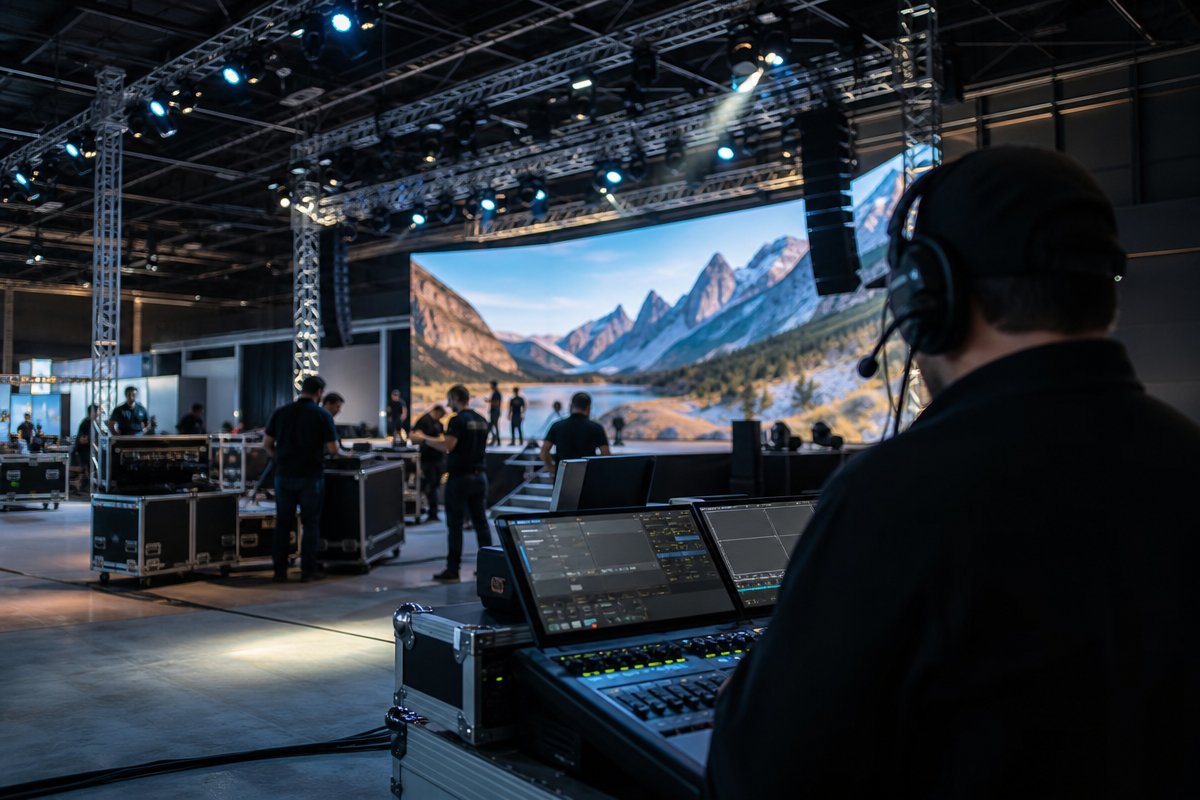
If a production company genuinely operates on an end-to-end model, their capabilities should span every phase of your event – from the first strategy conversation to the final load-out. Here is what that looks like in practice:
1. Strategy and Creative Development
Production does not start with equipment. It starts with intent. A legitimate full-service partner begins by understanding your event objectives, audience profile, brand standards, and success metrics. They translate those goals into a creative production concept – including scenic design, stage layout, content strategy, and show flow – before a single piece of gear is specified.
2. Audio Solutions
This means far more than dropping speakers in a ballroom. Proper audio production includes:
- Room analysis and acoustic assessment
- Speaker system design matched to venue dimensions and audience size
- Wireless microphone coordination and frequency management
- Monitor mixes for presenters and performers
- Audio mixing by an experienced live engineer
- Backup systems and redundancy planning
3. Visual Technology: LEDs, Projection, and Monitors
LED video walls, projection mapping, confidence monitors, IMAG screens – visual technology is often the most visible (and most expensive) element of event production. A full-service provider designs the visual environment as an integrated system, ensuring content resolution, aspect ratios, brightness levels, and rigging requirements are all coordinated before the truck arrives at the loading dock.
4. Lighting Design
Lighting sets the emotional tone of every moment in your event. Full-service production includes theatrical lighting design, architectural washes, spotlight operation, color programming for brand consistency, and the ability to shift moods between segments – from an energetic opening to an intimate awards presentation.
5. Staging and Scenic
Custom staging, scenic builds, branded backdrops, set pieces, podiums, risers – all of these need to be engineered for safety, aesthetics, and functionality. In a true end-to-end model, the scenic team is in constant communication with audio, lighting, and video departments because every physical structure on stage affects every other production discipline.
6. Video Production and Live Streaming
From multi-camera live capture to real-time graphic overlays, video switching, and hybrid event streaming, video production in 2026 demands broadcast-level quality. A full-service company handles camera operation, directing, signal routing, recording, and streaming distribution without requiring you to hire a separate video crew.
7. Show Management and Technical Direction
This is the element that separates real full-service providers from everyone else. Show management includes:
- Detailed show flow and cue-by-cue scripting
- Technical direction and stage management
- Speaker and presenter coordination
- Rehearsal management
- Real-time problem solving during the live event
- Communication systems for production crew
Without professional show management, even the best equipment in the world is just expensive furniture.

Five Questions That Expose Whether a Vendor Is Truly Full-Service
Before you sign a contract with any production company in the DC, Maryland, or Northern Virginia area, ask these five questions. The answers will tell you immediately whether you are dealing with a genuine end-to-end partner or a vendor wearing a bigger label than they deserve.
- ‘Do you employ your own technical directors and show callers, or do you subcontract them?’ – A company that outsources its leadership roles is not truly integrated.
- ‘Can you show me a single, unified production schedule that covers audio, video, lighting, staging, and show flow?’ – If these are separate documents from separate teams, you are coordinating vendors, not hiring a production company.
- ‘Who is my single point of contact from pre-production through load-out?’ – If the answer is ‘it depends on the phase,’ you do not have a production partner. You have a relay race.
- ‘What happens if a critical piece of equipment fails during my event?’ – Full-service companies carry backup systems and have contingency protocols. Rental houses tell you to call their office on Monday.
- ‘How do you handle the creative and strategic elements of production, not just the technical execution?’ – If they cannot articulate a creative process, they are a labor and equipment provider, not a production company.
The Real Cost of Going Piecemeal vs. Full-Service
One of the most persistent misconceptions in event planning is that hiring individual vendors saves money compared to engaging a full-service production company. On a line-item basis, this can appear true. A freelance lighting designer may charge less than the lighting line item in a comprehensive production proposal. An LED wall rental company may undercut the display technology cost from an integrated provider.
But this comparison ignores three significant hidden costs:
Coordination Labor
When you hire five separate vendors, you become the production manager. Every hour you spend reconciling timelines, mediating technical disagreements, and chasing vendor deliverables is an hour you are not spending on attendee experience, stakeholder management, or the hundred other things on your plate. For corporate and organizational event planners in the DMV, this coordination burden often translates to 40-60 additional hours of labor per event.
Risk Exposure
Each vendor boundary is a potential failure point. When the lighting company and the AV company have never worked together, the risk of a power distribution conflict, a signal routing error, or a simple scheduling miscommunication increases dramatically. The cost of even one visible technical failure at a high-profile DC event – a government briefing that loses audio, a gala where the video wall goes dark during the honoree reel – is incalculable in terms of organizational reputation.
Missed Creative Potential
When production disciplines operate in silos, they optimize individually instead of collectively. A lighting designer working in isolation will create beautiful lighting. But a lighting designer working alongside a video director, scenic designer, and show caller will create moments – coordinated, multi-sensory experiences that move audiences and achieve event objectives. That creative integration is simply not possible in a piecemeal model.

What to Expect from a Genuine Full-Service Partner in the DMV
The Washington DC, Northern Virginia, and Maryland event market is uniquely demanding. Between government security protocols, association conference standards, venue union rules, and the sheer expectations of Beltway audiences, production companies operating in this region need capabilities that go far beyond plugging in speakers and pointing lights at a stage.
A genuine full-service event production partner in this market should demonstrate:
- Deep venue knowledge – familiarity with the load-in logistics, power infrastructure, rigging points, and operational quirks of major DMV venues
- Scalability – the ability to produce a 50-person executive briefing with the same quality standards as a 5,000-person convention
- Compliance awareness – understanding of federal event requirements, accessibility standards, and security protocols common to DC-area events
- Owned inventory – maintaining their own equipment warehouse rather than renting everything from third parties, which ensures quality control and faster response times
- Experienced crew – technicians, engineers, and directors who have worked together repeatedly and operate as a cohesive unit rather than a collection of day-hires
- Longevity and references – a track record measured in decades, not months, with verifiable client relationships
Frequently Asked Questions About Full-Service Event Production
What is the difference between full-service event production and AV rental?
AV rental provides equipment – speakers, screens, projectors, microphones – that you or your team operate and manage. Full-service event production provides the complete production ecosystem: strategy, creative design, equipment, technical personnel, show management, and on-site execution. The rental company gives you tools. The production company gives you a team, a plan, and a flawless show.
How far in advance should I book a full-service production company for a 2026 event in DC?
For large-scale events (500+ attendees, multi-day conferences, or events requiring custom scenic builds), six to twelve months of lead time is ideal. For mid-size corporate events, three to six months is typically sufficient. The DC market is exceptionally competitive for prime dates, especially during peak association and government event seasons in spring and fall, so earlier engagement gives you better access to top crews and equipment.
Can a full-service production company work with my existing vendors or venue AV team?
Yes. Reputable full-service companies regularly collaborate with venue teams, florists, caterers, entertainment agencies, and other event vendors. The difference is that the production company serves as the technical and creative anchor, ensuring all elements integrate properly. This is very different from asking a planner to coordinate those relationships independently.
Is full-service event production only for large events?
Not at all. While the model is essential for large, complex productions, it is equally valuable for high-stakes events of any size. A 75-person executive retreat with a critical leadership presentation benefits enormously from professional show management, proper audio engineering, and cohesive lighting and video design. The scale changes; the need for integration does not.
What should a full-service event production proposal include?
A thorough proposal should include: a creative and strategic overview, detailed equipment specifications for every production discipline (audio, video, lighting, staging, LED), a staffing plan identifying key personnel by role, a production timeline covering pre-production through load-out, a site plan or CAD drawing, contingency and backup provisions, and a transparent cost breakdown. If the proposal reads like an equipment rental quote with labor added, it is not a full-service proposal.
How do I evaluate whether a production company can truly deliver end-to-end service?
Ask for case studies or references from events of similar scale and complexity. Request a walkthrough of their pre-production process. Visit their warehouse if possible. Ask specifically about who will serve as your technical director and show caller, and whether those individuals are employees or freelancers. A company with 20 or 30 years of experience serving corporate and organizational clients in a demanding market like the DMV has earned that credibility through consistent delivery, not just marketing.
Stop Coordinating Vendors. Start Producing Events.
The difference between a good event and a defining one is rarely a single piece of equipment or a single talented technician. It is the integration – audio, video, lighting, staging, scenic, content, and show management coordinated as one production, on one cue sheet that serves your audience and achieves your objectives.
That is what full service event production actually means. Not a buzzword. Not a marketing label. A fundamentally different approach to how your event is planned, designed, and delivered.
TriVision Event Production has provided genuine end-to-end event production services to corporate and organizational clients across Washington DC, Northern Virginia, and Maryland for over 30 years. From strategy and creative development through final load-out, our team owns every element of your production under one roof, one plan, and one point of accountability. If you are planning a 2026 event and want to understand what true full-service support looks like for your specific needs, contact TriVision Event Production to start a conversation.
Let’s talk about your event
Tell us the date and the room - we’ll bring the plan.