
Quick answer: Multi-day conference production is a different discipline from single-day events because complexity compounds each day. Success depends on staggered crew scheduling with structured shift handoffs, a disciplined content-rollover workflow with nightly content locks, aggressively standardized breakout-room equipment packages, and a minute-by-minute master production timeline as the single source of truth. For DC conferences of 500-plus attendees running three or more days, book a production partner 6–9 months out; full production typically ranges from $150,000 to $500,000 or more.
Running a single-day event is demanding enough. Now multiply the logistics by three, four, or five consecutive days – each with its own agenda, keynote speakers, breakout sessions, and technical requirements – and you begin to understand why multi-day conference production services DC planners rely on require a fundamentally different approach than standard event support. Multi-day conferences represent a huge share of B2B event spending in the United States, yet they are also where on-site technical failures happen most often when production management is treated as an afterthought. In Washington DC, where the stakes involve federal agencies, national associations, and Fortune 500 audiences, there is zero room for those failures.
This post is not a surface-level checklist. It is a project-management deep dive into the unique challenges of producing multi-day conferences at scale – crew scheduling, content rollover, breakout room logistics, and the dozens of operational decisions that separate a well-run conference from a chaotic one. If you are planning a multi-day conference in the DMV region in 2026, this is the guide your team needs before signing a single vendor contract.

Why Multi-Day Conference Production Is a Different Discipline Entirely
Many event planners make the mistake of thinking a multi-day conference is simply a one-day event repeated several times. In reality, it is an entirely different production discipline. Here is why:
Compounding Variables
Each additional day introduces exponential complexity. Day two does not just add another set of sessions – it adds overnight equipment resets, crew fatigue management, content updates from the previous day’s sessions, and the need to maintain audience energy across a longer arc. By day three or four, small inefficiencies that were invisible on day one have compounded into significant operational drag.
Venue Wear and Shared Spaces
Washington DC’s premier conference venues – the Walter E. Washington Convention Center, the Marriott Marquis, the Gaylord National Resort – were designed for multi-day use, but that does not mean logistics are simple. Ballrooms may need to transform from a general session format to a gala layout overnight. Breakout rooms share walls with concurrent sessions, creating audio bleed risks. Loading docks have time-slot restrictions that affect when equipment can be moved. A production partner who understands these venue-specific constraints is not optional – it is essential.
Stakeholder Multiplication
A single-day event might involve one client contact and a handful of speakers. A multi-day conference can involve a planning committee, multiple sponsors with branded content requirements, dozens of presenters with varying levels of technical sophistication, and an AV team that must serve all of them simultaneously. Without a centralized production management structure, communication fractures fast.
Crew Scheduling: The Hidden Make-or-Break Factor
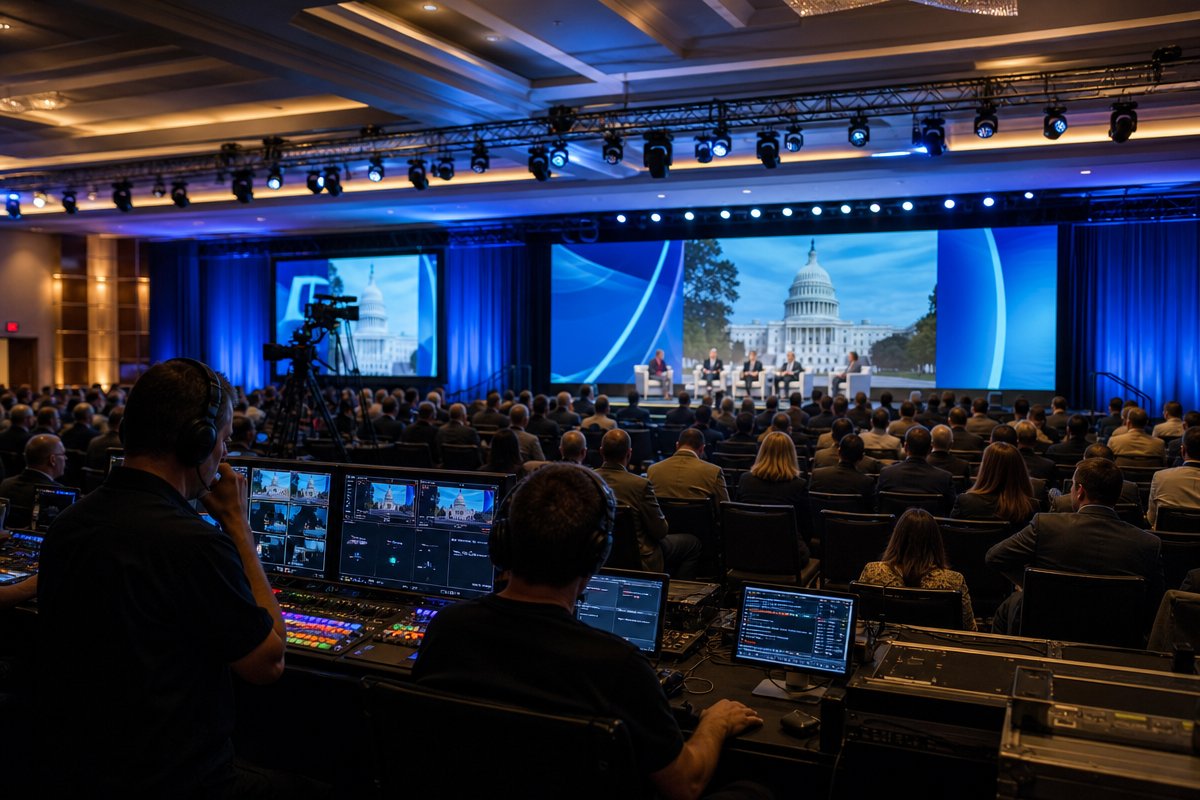
Ask any experienced production company what the single biggest operational risk is on a multi-day conference, and most will give you the same answer: crew management. It is not the technology that fails – it is the people running the technology who get stretched too thin.
Staggered Shifts vs. Marathon Days
A common mistake is booking the same crew for every hour of a four-day conference. Union and non-union labor laws in DC and Maryland establish clear guidelines on shift lengths, overtime thresholds, and mandatory rest periods. Beyond the legal requirements, there is a practical reality: a technician who has been running audio for 14 hours straight will miss the subtle feedback loop that a fresh operator catches instantly.
Professional multi-day conference production requires staggered crew scheduling – overlapping shifts that ensure every critical position is staffed by someone who is alert and focused. This means:
- A-team and B-team rotations for audio engineers, camera operators, lighting technicians, and show callers
- Dedicated overnight reset crews that handle room flips, equipment checks, and content loading while the day crew rests
- A technical director who is present for all key transitions even if individual technicians rotate
- Backup personnel on standby for illness, travel delays, or unexpected scope expansion
The Briefing Cascade
When crew members rotate, institutional knowledge can walk out the door with the outgoing shift. The solution is a structured briefing cascade: end-of-day technical debriefs, written shift notes logged in a shared production platform, and morning pre-show briefings where the incoming crew reviews the day’s run-of-show, known issues from the previous day, and any client-requested changes. At TriVision, this briefing process is built into every multi-day production schedule because we have learned – across 30-plus years of producing complex events in DC – that verbal handoffs alone are not reliable enough.

Content Rollover: Managing the Data Pipeline Across Days
Content rollover is one of the most underestimated challenges in multi-day conference production. It refers to the process of receiving, formatting, loading, testing, and cueing presentation content – and then doing it all over again the next day with new or revised materials.
The Presenter Bottleneck
Here is a scenario every conference producer knows too well: it is 11 PM on day two, and a keynote speaker for the day-three opening session just emailed a completely revised PowerPoint deck with embedded video files that were not in the original version. The videos are in a format that does not play natively on the media server. The slides use custom fonts that are not installed on the show machines. And the speaker wants confidence monitors with notes view.
Solving this at 11 PM requires a content management workflow that was established weeks before the event:
- Pre-event content collection with hard deadlines enforced 7-10 days before the conference
- A standardized presentation template distributed to all speakers with embedded font packages and approved video codecs
- A dedicated content manager on-site whose sole job is receiving, converting, testing, and loading presentations
- A nightly content lock – a firm cutoff time after which no presentation changes are accepted without technical director approval
- Redundant playback systems so that content for the next day can be loaded and tested on a backup machine without interrupting the current day’s sessions
Dynamic Content: Live Polling, Social Feeds, and Session Recaps
Modern multi-day conferences increasingly feature dynamic content – live polling results displayed on LED walls, social media aggregation feeds, and day-one recap videos shown at the day-two opening. Each of these requires real-time content pipelines that must be tested, monitored, and troubleshot independently of the main presentation workflow. A production team that only knows how to advance slides is not equipped for this level of complexity.
Breakout Room Logistics: Scaling Production Without Scaling Chaos
The general session gets most of the attention during planning, but breakout rooms are where multi-day conferences most often fall apart operationally. A major DC conference might run 8-12 concurrent breakout sessions across multiple floors of a convention center. Each room needs audio, projection, lighting, and often recording or streaming capabilities.
Standardization Is the Strategy
The most effective approach to breakout room production is aggressive standardization:
- Identical equipment packages in every breakout room – same projector model, same microphone type, same switcher – so that any technician can troubleshoot any room without learning a new system
- Pre-built cable harnesses and rack cases that can be deployed and struck rapidly during overnight resets
- A centralized AV help desk or NOC (Network Operations Center) that monitors all rooms from a single location, dispatching roving technicians as issues arise
- Room captain assignments – one technician responsible for 2-3 adjacent breakout rooms, physically rotating between them on a timed schedule
The Flip Problem
Many multi-day conferences require breakout rooms to change configuration between sessions – from theater seating to roundtable discussion, from a panel stage to a workshop layout with hands-on demo stations. Each flip has a cascading effect on AV: microphone placements change, projection angles shift, lighting cues need adjustment, and speaker monitoring positions move. Without a detailed flip schedule that is integrated into the master production timeline, these transitions eat into session time and create visible chaos that undermines the attendee experience.
Audio Isolation
Audio bleed between adjacent breakout rooms is one of the most common complaints at multi-day conferences in DC’s convention spaces. Production-level solutions include directional speaker arrays, volume limiters programmed into the mixing console, acoustic baffling panels on shared walls, and – when budget allows – in-ear or tabletop personal audio systems for smaller discussion-format sessions. An experienced DC production company will conduct a venue walkthrough specifically to identify audio isolation risks before the event.
The Master Production Timeline: Your Single Source of Truth
Every element discussed above – crew rotations, content pipelines, breakout logistics, room flips – must converge into a single document: the master production timeline. This is not the same as the attendee-facing agenda. It is a minute-by-minute operational document that includes:
- Load-in and load-out schedules with dock reservations and freight elevator bookings
- Crew call times for every shift on every day
- Content deadlines and nightly lock times
- Room flip windows with assigned personnel
- Rehearsal slots for keynote speakers and VIP presenters
- Sponsor activation setup and strike times
- Meal breaks and crew catering logistics
- Contingency buffers – built-in time padding for the inevitable surprises
At TriVision, we build master production timelines collaboratively with our clients, typically starting 8-12 weeks before a multi-day conference. The document goes through multiple revisions, each one incorporating new information from venue site visits, speaker confirmations, and sponsor requirements. By the time load-in begins, every member of the production team has a copy, and every decision can be traced back to a specific line in the timeline.
Risk Management for Multi-Day Events in 2026
Multi-day conferences concentrate significant investment – financial, reputational, and logistical – into a compressed timeframe. Risk management is not paranoia; it is professionalism.
Equipment Redundancy
Critical systems require backup: a second media server loaded with the same content, backup wireless microphone frequencies pre-scanned and programmed, spare projector lamps (or an entire spare projector for the general session), and UPS battery backups on all primary systems. The cost of redundancy is a fraction of the cost of a 20-minute blackout in front of 2,000 attendees.
Weather and Power Contingencies
DC’s summer storm season can knock out venue power with little warning. Multi-day conferences that extend into outdoor spaces – courtyards, terraces, loading areas used for receptions – need weather contingency plans that include rapid strike procedures, indoor backup locations, and generator power for critical AV systems.
Cybersecurity for Hybrid Components
In 2026, most multi-day conferences include some hybrid or virtual component – live streaming, remote presenter integration, or on-demand session recording. Each of these introduces cybersecurity considerations: secure streaming endpoints, password-protected presenter green rooms, and network segmentation to isolate production systems from the venue’s public Wi-Fi. This is especially critical for government and association conferences in DC where attendee data and session content may be sensitive.
Frequently Asked Questions About Multi-Day Conference Production in DC
How far in advance should we book a production company for a multi-day conference in DC?
For conferences of 500 or more attendees running three or more days, we recommend booking your production partner 6-9 months in advance. DC’s event calendar is dense – particularly in spring and fall – and experienced production companies with the crew depth and equipment inventory for multi-day events book early. Starting the conversation at least 9 months out gives you time for thorough venue walkthroughs, content workflow planning, and crew scheduling without last-minute compromises.
What is the typical crew size for a multi-day conference with breakout sessions?
It depends on the number of concurrent rooms and the complexity of the general session, but a representative example would be: a 4-day conference with one general session and 8 breakout rooms might require 25-35 crew members per shift, with two shifts per day, plus overnight reset personnel. That can mean 50-70 total crew across the event. An experienced production company will provide a detailed crew plan as part of the proposal.
How do you handle last-minute speaker presentation changes during a multi-day event?
Through a structured content management workflow with a dedicated on-site content manager, nightly content lock deadlines, and redundant playback systems. Changes submitted before the lock time are tested and loaded onto backup machines without disrupting the current day’s sessions. Changes after the lock require technical director approval and may involve a pre-session tech check with the speaker the morning of their presentation.
Can one production company handle both the general session and all breakout rooms?
Yes – and in fact, this is strongly preferred. Using a single production company for all rooms ensures consistent equipment standards, unified crew management, centralized communication, and a single point of accountability. Splitting production across multiple vendors for different rooms introduces coordination gaps that are especially dangerous on multi-day events where overnight resets and content rollover require disciplined crew-to-crew handoffs.
What makes DC venues uniquely challenging for multi-day conference production?
DC venues often have strict load-in/load-out windows due to back-to-back bookings, union labor requirements that vary by venue, security protocols (especially for government-adjacent events), and logistical constraints like limited freight elevator access and noise ordinances. A production company with deep DC venue experience – like TriVision, which has operated in the DMV market for over 30 years – knows these constraints intimately and plans around them proactively rather than reactively.
What is the cost range for multi-day conference production in DC?
Costs vary enormously based on scope, but a fully produced 3-5 day conference with a general session, 6-10 breakout rooms, LED walls, professional lighting, audio, video switching, streaming, and full crew typically ranges from $150,000 to $500,000+ for production services. The key is understanding what drives cost – crew days, equipment quantity, and content complexity – so you can make informed trade-offs during planning rather than facing surprise invoices after the event.
Partner With a Production Team That Thinks in Days, Not Hours
Multi-day conference production in DC is not about having more equipment – it is about having a production management methodology that anticipates complexity before it becomes crisis. It is about crew depth, content discipline, breakout standardization, and a master timeline that keeps every moving part synchronized across every day of your event.
TriVision Event Production has been delivering multi-day conference production services DC organizations trust for over three decades. From the Walter E. Washington Convention Center to intimate hotel conference suites across Northern Virginia and Maryland, we bring the crew depth, equipment inventory, and operational discipline that multi-day events demand. If you are planning a conference in 2026 and need a production partner who understands what it takes to manage complexity at scale, contact the TriVision team today to start the conversation.
Let’s talk about your event
Tell us the date and the room - we’ll bring the plan.